
greek-and-roman-deities-on-coins-26
2026-02-11 Wed
In #ancient #Greek religion, Castor and Pollux are known as #Twin half-brothers. Together, they are called the Dioscuri, or Dioskouroi, meaning "sons of #Zeus." However, their backgrounds are different. Their mother is Leda, while their fathers are not the same; Castor is the mortal son of Tyndareus, the #King of Sparta, whereas Pollux is the #Divine son of Zeus, who came to Leda as a #SWAN. Showing #loyalty, Pollux asked Zeus to give some of his immortality to Castor, which kept them together. They were later turned into the #constellation #Gemini.In Latin, the twins are known as Gemini, meaning "twins," or Castores. They are also called the Tyndaridae or Tyndarids. They are famous for saving #people in #DANGER at sea or during wars. They are especially linked to horses and #sports. Their importance continued throughout the #Roman Republic, where they were patrons of the Roman knights.
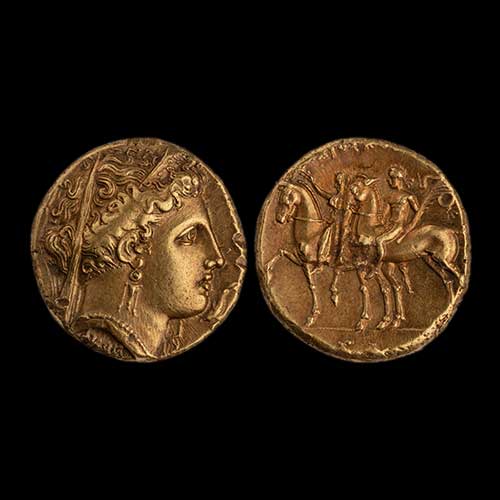
Artistic depictions of the Dioscuri in Greek culture usually show them as young horsemen wearing wide-brimmed travel hats. Their #images started appearing on coins around the 4th century BCE. The #COIN shown in this post is a #GOLD Stater from Calabria in Taras, dating from 315 to 310 BCE. Taras is an ancient Greek #City-state in #southern #Italy. Weighing 8.6 grams, the obverse of the coin features the head of #Hera, facing right and wearing a stephane, an ancient #Crown for goddesses and queens, along with a #Veil. For more information about Hera, you can follow this link: Greek And Roman Deities On Coins-17. The reverse coin depicts the Dioscuri on horses, riding left, side by side.
Interestingly, the #Indian deities known as the Ashvins/Ashvini Kumaras/Asvinau have traits in common with the Dioscuri. The Rigveda describes them as young divine twin horsemen traveling in a chariot pulled by horses. They are seen as guardian deities, dedicated to protecting and helping people in various situations.
Latest News
-
The Elephant on an Indo-Greek Silver Drachm of Apollodotus I
2026-09-22 TueElephants were not just an important part of Indian heritage and religious traditions; they also ...
-
Gajalakshmi Flanked by Elephants on a Post-Mauryan Ujjaini Copper Coin
2026-09-22 TueThe association between Gajalakshmi and elephants is one of the most enduring motifs in Indian re...
-
Elephant Head on a Bronze Coin of Indo-Scythian King Maues
2026-09-21 MonAs the eighth day of Ganesh Utsav is celebrated, the elephant once again provides a fascinating l...
-
A Remarkable Elephant-and-Lion Standard on Vrishni Coinage
2026-09-21 MonAs Ganesh Utsav continues, the elephant once again offers a fascinating doorway into India’s an...
-
Elephant and Lion on a Cooch Behar Royal Coin
2026-09-19 SatThe elephant occupies a distinctive place in the cultural traditions of eastern India, particular...