
2026-08-04 Tue
The Kidarites, also known as the Kidara Huns, were a dynasty of Central Asian origin that ruled parts of Bactria (northern Afghanistan, southern Uzbekistan, and southwestern Tajikistan), Sogdiana, and northwestern India (Gandhara, Punjab, and possibly Kashmir) during the 4th and 5th centuries CE. They were the first of the major “Iranian Huns” or Xionite/Huna groups to establish power in the region, later followed by the Alchon Huns, Hephthalites, and Nezak Huns.
The Kidarites issued a significant series of coins that constitute one of the most important sources for reconstructing their history. Their coinage is transitional in character: it continues the traditions of the Kushans and Kushano-Sasanians while introducing new elements that mark the beginning of “Hunnic” (Xionite) coinages in Central Asia and northwestern India.
Kidara and his successors frequently used the title Kushanshah (“King of the Kushans”) in Bactrian, Brahmi, or Pahlavi scripts. This was a deliberate claim to legitimacy as successors of the Kushan Empire. The coinage helps date their takeover of Bactria from the Kushano-Sasanians and their subsequent expansion into Gandhara and the Punjab. It also forms a bridge between the earlier Kushan–Kushano-Sasanian monetary tradition and the later coinages of the Alchon Huns and Hephthalites.
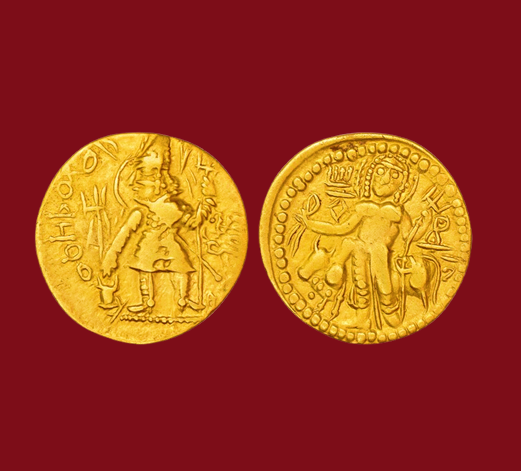
The gold dinar shown above imitates the style of late Kushan coinage (particularly issues associated with Vasudeva II and related rulers). The obverse depicts a nimbate king wearing a conical helmet and armour, standing and holding a trident while offering a sacrifice at an altar; a trident standard with pennants appears in the background, accompanied by a Bactrian legend. The reverse shows a nimbate Shiva (Oesho) standing and reclining against the bull Nandi, with the Bactrian legend “OEShO” to the right and a tamgha to the left. The coin weighs 7.74 gram.
-
The Elephant on an Indo-Greek Silver Drachm of Apollodotus I
2026-09-22 TueElephants were not just an important part of Indian heritage and religious traditions; they also ...
-
Gajalakshmi Flanked by Elephants on a Post-Mauryan Ujjaini Copper Coin
2026-09-22 TueThe association between Gajalakshmi and elephants is one of the most enduring motifs in Indian re...
-
Elephant Head on a Bronze Coin of Indo-Scythian King Maues
2026-09-21 MonAs the eighth day of Ganesh Utsav is celebrated, the elephant once again provides a fascinating l...
-
A Remarkable Elephant-and-Lion Standard on Vrishni Coinage
2026-09-21 MonAs Ganesh Utsav continues, the elephant once again offers a fascinating doorway into India’s an...
-
Elephant and Lion on a Cooch Behar Royal Coin
2026-09-19 SatThe elephant occupies a distinctive place in the cultural traditions of eastern India, particular...