
2026-08-06 Thu
Ganga Singh (13 October 1880 – 2 February 1943) ascended the throne of Bikaner in 1887/1888 as a young boy following the death of his brother and predecessor, Dungar Singh. After a period of British regency, he assumed full powers and ruled until his death, one of the longest reigns among the Rajputana princes. He is remembered for major public works, most notably the Ganga Canal whose foundation was laid exactly 1 centenary ago, which brought irrigation to arid regions of Bikaner and transformed agriculture. He introduced Representative Assembly, a high court, and social reforms such as Bank for his masses, Endowment Assurance Scheme for employees and Sharda Act to end child marriages.
He commanded the Bikaner Camel Corps, served in the Boxer Rebellion in China (1900), and represented India in the British Imperial War Cabinet during the First World War. He was the only non-White member of that body and attended the Versailles Peace Conference.
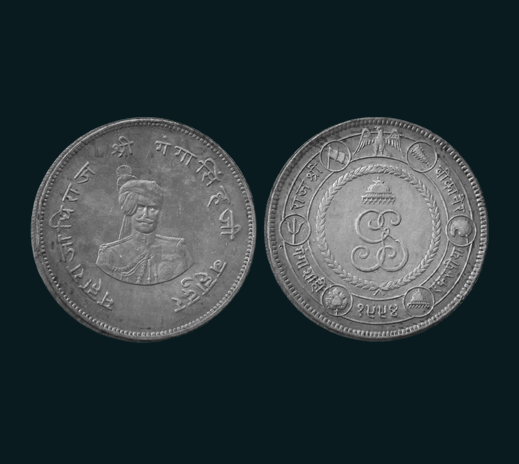
On the occasion of Golden Jubilee, 1937, he issued a series of Nazarana: gold Mohurs, half-Mohurs, and silver Rupees. These were not intended for everyday commerce. These medallic coins capture a moment when a progressive Indian prince celebrated half a century of rule under the paramountcy of the British Crown, yet still asserted his own sovereignty through traditional forms of honour and gift-giving.
His issues mark the transition from traditional hand-struck coins with Persian legends and Hijri (AH) dating to modern machine-struck coins featuring Devanagari script, Vikram Samvat (VS) dates, and, the ruler’s own portrait for the first time in Bikaner state.
Here, the silver rupee weighs 8.53 gram. The obverse depicts bust of Maharaja Ganga Singh wearing a jewelled turban and military uniform with decorations with Devanagari legends “Maharajadhiraj Sri Ganga Singhji Bahadur”. The reverse features coat of arms of the state, legends “Raja Sri”, “Ganga Singh”, “Ek Rupiya” and “Bikaner”, surrounded by 6 small symbols of royalty in smaller circle.
-
Mithuna (Couple) Type Coin from the Post-Mauryan Ujjaini Region
2026-11-17 TueContinuing our exploration of the distinctive coinage of the Post-Mauryan Ujjaini region, let us ...
-
Lord Shiva Standing Type Copper Coin of the Ujjaini Region from Post-Mauryan Period
2026-11-17 TueThe Post-Mauryan period (200 BCE–300 CE) witnessed the emergence of several regional kingdoms, ...
-
Rare Silver 1½ Shana Punch-Marked Coin of Panchala Janapada
2026-11-16 MonThe Panchala Janapada was one of the sixteen Mahajanapadas of ancient India, flourishing during t...
-
Earth God on Panchala Copper Coin of King Bhumimitra
2026-11-16 MonThe ancient kingdom of Panchala was one of the prominent Mahajanapadas of northern India. Located...
-
Silver Punch-Marked Coin of Vidarbha Janapada – Melghat Region
2026-11-13 FriThe emergence of Janapadas during the ancient period marked an important phase in India's politic...