
2026-08-06 Thu
Maharaja Sayajirao Gaekwad III stands as one of the most remarkable rulers of India’s princely states. He ruled for nearly 64 years, from 1875 until his death. He transformed a traditional Maratha kingdom into a model of progressive governance, social reform, and modern development. The term “Baroda” derives from native name, Vadodara which can be traced back to Sanskrit word “vatodara” meant ‘Heart of the Banyan tree’.
His reign is remembered for far-reaching social and educational reforms that placed Baroda decades ahead of other princely states and British India as well. In 1906 he made free and compulsory primary education. He opened schools for girls and for children from depressed classes, established training colleges for women teachers, and built an extensive network of libraries, with the Central Library of Baroda as its nucleus.
He banned child marriage, legalized widow remarriage, permitted divorce, discouraged the practice of purdah, and took steps against untouchability.
In 1908 he founded the Bank of Baroda, which evolved into one of India’s leading banks today. He expanded the Gaekwar’s Baroda State Railway into one of Asia’s largest narrow-gauge networks, improved irrigation and water supply, and promoted industry, agriculture, and public health. He separated the judiciary from the executive and invested in roads, sanitation, and civic amenities, including the beautiful Sayaji Baug public park.
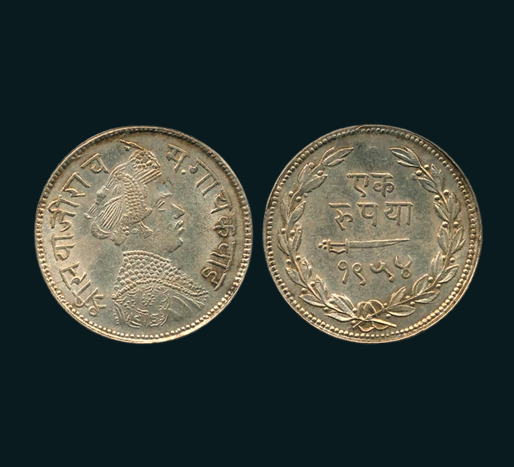
His issues mark the transition from traditional hand-struck coins with Persian legends and Hijri (AH) dating to modern machine-struck coins featuring Devanagari script, Vikram Samvat (VS) dates, and, the ruler’s own portrait for the first time in Baroda’s history. He issued coins in copper – 1 paisa and 2 paisa, silver – 2 annas, 4 annas, ½ rupee, and 1 rupee and in gold – 1/6, 1/3, and 1 Mohur.
The image shows silver Rupee weighs 11.38 gram. The obverse depicts crowned bust of Maharaja Sayajirao III facing right, wearing a jeweled turban with legends, “श्री सयाजीराव म. गायकवाड”. The reverse features Scimitar, “1954” VS date within wreath.
-
Mithuna (Couple) Type Coin from the Post-Mauryan Ujjaini Region
2026-11-17 TueContinuing our exploration of the distinctive coinage of the Post-Mauryan Ujjaini region, let us ...
-
Lord Shiva Standing Type Copper Coin of the Ujjaini Region from Post-Mauryan Period
2026-11-17 TueThe Post-Mauryan period (200 BCE–300 CE) witnessed the emergence of several regional kingdoms, ...
-
Rare Silver 1½ Shana Punch-Marked Coin of Panchala Janapada
2026-11-16 MonThe Panchala Janapada was one of the sixteen Mahajanapadas of ancient India, flourishing during t...
-
Earth God on Panchala Copper Coin of King Bhumimitra
2026-11-16 MonThe ancient kingdom of Panchala was one of the prominent Mahajanapadas of northern India. Located...
-
Silver Punch-Marked Coin of Vidarbha Janapada – Melghat Region
2026-11-13 FriThe emergence of Janapadas during the ancient period marked an important phase in India's politic...