
2026-08-07 Fri
Kaushambi, located near present-day Kosam in Uttar Pradesh, was one of the sixteen Mahajanapadas of ancient India and served as the political and commercial center of the Vatsa kingdom. After the decline of the Mauryan Empire, the city continued to issue its own distinctive cast copper coins during the post-Mauryan period (roughly 2nd century BCE to early centuries CE).
It is believed that such coins were produced in the post-Mauryan period, roughly between the 2nd century BCE and the early centuries CE, when Kaushambi flourished as a major political, commercial and cultural center on the banks of the Yamuna. The “lanky bull” variety is recognized for its elongated, stylized depiction of the animal, a motif that appears across several local copper series of the region.
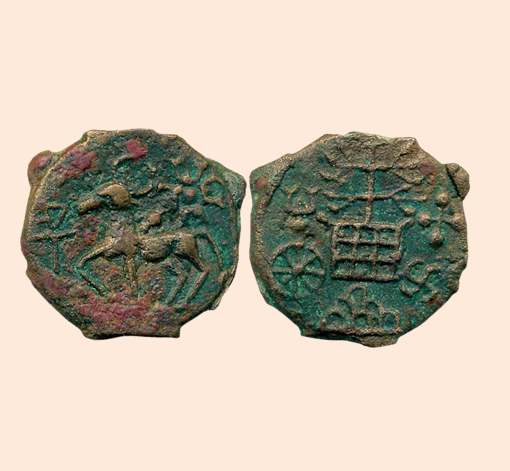
The combination of symbols such as Nandyavarta, Indradhvaja, the railed tree, six-arched hill, Nandipada, wheel, swastika and Ujjain mark reflects the rich symbolic vocabulary of early Indian coinage. These symbols are widely interpreted as auspicious emblems linked to fertility, sovereignty, religious identity and local authority rather than the personal names of rulers.
The coin stands as a quiet but eloquent reminder of the sophisticated monetary systems that once circulated along the trade routes of the Gangetic plain.
A rare copper coin from ancient Kaushambi, weighing 8.47 grams and belonging to the distinctive “Lanky Bull” type, has remarkably clear array of early Indian symbols.
On the obverse, a slender bull stands facing left, with a Nandyavarta symbol positioned above and an Indradhvaja (the standard of Indra) to its left. The reverse features a railed tree rising above a six-arched hill, accompanied by a wheel and Nandipada to the left, faint traces of a swastika, and the characteristic Ujjain symbol to the right.
-
Elephant Head on a Bronze Coin of Indo-Scythian King Maues
2026-09-21 Mon -
A Remarkable Elephant-and-Lion Standard on Vrishni Coinage
2026-09-21 Mon -
Elephant and Lion on a Cooch Behar Royal Coin
2026-09-19 Sat -
Gaja-Sardula: The Lion and Elephant on a Vijayanagara Coin
2026-09-19 Sat -
Elephant Featured on a Silver Punch Marked Karshapana
2026-09-18 Fri