
2026-11-13 Fri
The emergence of Janapadas during the ancient period marked an important phase in India's political, economic and monetary history. Between the 6th and 4th centuries BCE, several regional powers and independent political units developed across the Indian subcontinent. Alongside the growth of trade and commerce, these regions witnessed the development of distinctive coinage traditions, particularly silver punch-marked coins.
Among the lesser-known regional coinage traditions are the issues attributed to the Vidarbha Janapada, associated with the Vidarbha region of present-day Maharashtra. Vidarbha occupied an important geographical position in the Deccan, connecting different regions through trade routes and cultural interactions. Its ancient monetary tradition is represented by distinctive punch-marked coins discovered in different parts of the region, including Melghat and the Godavari Valley. These coins provide valuable evidence of early monetary activity and regional economic networks.
The coinage attributed to Vidarbha displays considerable variation in its weight, shapes and symbolic arrangements. These issues include fractional denominations of the Karshapana, suggesting the use of smaller units for commercial transactions. Their classification is generally based on the number, arrangement and combination of symbols punched onto the flan.
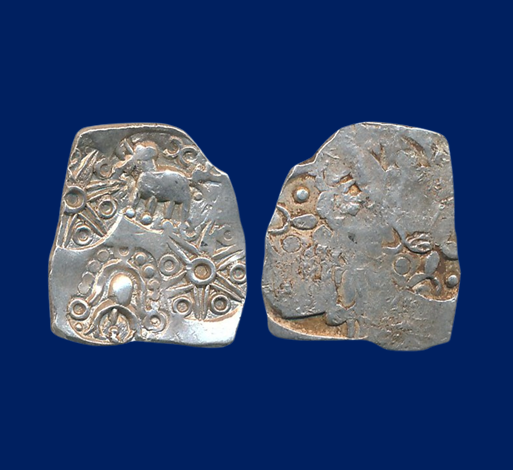
An interesting example from this tradition is a Silver Half Karshapana weighing 1.57 grams, attributed to the Vidarbha Janapada of the Melghat region. It belongs to Series II and follows a four-symbol configuration classified as the ABCB type.
The obverse features four distinct punches: an elephant walking towards the left, two six-pointed stars and one unidentified symbol. The elephant is a particularly fascinating motif in ancient Indian coinage, frequently associated with royal authority, strength and prosperity. The six-pointed star symbols add a geometric element to the overall design, while the unidentified symbol reflects the diversity of motifs employed by early monetary authorities.
The reverse exhibits traces of earlier punches, indicating the repeated application of symbols during the coin-production process.
-
Gold Pagoda of Jagaddeva, Paramara Ruler of Vidarbha
2026-11-13 FriThe Paramaras were an influential Rajput dynasty that established their power in central India, w...
-
Silver Portrait Drachma of Gautamiputra Siri Yajna Satakarni, Satavahanas
2026-11-12 ThuThe Satavahanas were among the most prominent ancient Indian dynasties, ruling large parts of the...
-
Exploring the Kuras of Kolhapur through Its Coinage
2026-11-12 ThuThe Kuras were among the lesser-known ruling dynasties of ancient India, whose coins provide valu...
-
Anandas of Banavasi – Rano Visnu Rudra Buddhananda, Bull to Left Type
2026-11-11 WedLet us have a look at another fascinating coin from the Anandas of Banavasi, continuing our explo...
-
Striking Lead Coin of the Anandas of Banavasi
2026-11-11 WedThe Anandas of Banavasi represent an important chapter in the early historic coinage of Karnataka...