
2026-11-11 Wed
The Anandas of Banavasi represent an important chapter in the early historic coinage of Karnataka. Also associated with the Chutu dynasty or Chutu-Satakarni rulers, the Anandas exercised political authority over the Banavasi region, known in ancient times as Vaijayanti, in present-day Uttara Kannada district. Their rule is generally placed between the second and third centuries CE, following the decline of Satavahana power in the region.
Banavasi emerged as an important political, religious and commercial centre of ancient Karnataka. Its favourable geographical setting, natural resources and trading connections contributed to the prosperity of the settlement. Archaeological discoveries, including coins, inscriptions, pottery, beads and other antiquities, provide valuable evidence of its economic and cultural development.
The Ananda rulers issued coins in different metals, including potin, copper and lead. Their coinage is particularly interesting for its distinctive designs and the use of symbolic motifs such as the arched hill, tree-in-railing, Nandipada, Shrivatsa and other religious emblems. Coins bearing the names of rulers such as Chutukulananda, Mulananda and Sivalananda have helped historians reconstruct the political history of this relatively lesser-known dynasty.
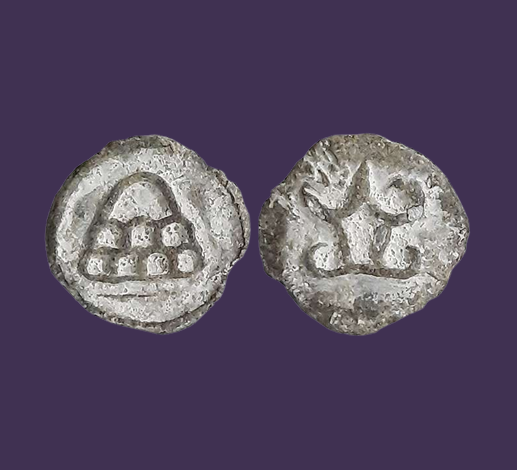
The featured coin is an interesting anonymous Hill-Standard Type, struck in lead, weighing 3.24 grams and classified as a Unit. Unlike the inscribed issues of certain Ananda rulers, this specimen does not carry an identifiable royal name, making its attribution to an individual ruler difficult.
The obverse depicts an eight-arched hill, a characteristic motif frequently encountered on the coinage of the Banavasi region. The arched hill, also described as a Chaitya or Stupa symbol, is an important element of early Indian numismatic iconography and reflects the religious and artistic traditions of the period.
The reverse features the Shrivatsa symbol, an auspicious emblem widely represented in ancient Indian art and coinage. Its appearance on this coin adds to the distinctive symbolic vocabulary of the Ananda issues.
What makes this specimen particularly appealing is its deep, beautiful strike, which brings out the details of both the eight-arched hill and the Shrivatsa symbol. Despite its modest weight and simple composition, the coin offers a fascinating glimpse into the regional monetary traditions of early historic Karnataka.
-
Anandas of Banavasi – Rano Visnu Rudra Buddhananda, Bull to Left Type
2026-11-11 WedLet us have a look at another fascinating coin from the Anandas of Banavasi, continuing our explo...
-
Rare Silver Dramma of Aparaditya, Shilaharas of North Konkan
2026-11-10 TueThe Shilaharas were an important ruling dynasty of western India, who governed different regions ...
-
Silver Dramma of Rashtrakuta King Amoghavarsha I
2026-11-10 TueThe Rashtrakutas were among the most powerful imperial dynasties of early medieval India, ruling ...
-
Goddess Lakshmi on a Gold Half Varaha of Harihara II, Vijayanagara Empire
2026-11-06 FriOn the auspicious occasion of Diwali, the festival of lights, prosperity and new beginnings, we c...
-
Celebrating Dhanteras with a Magnificent Gold Dinar of Chandragupta II
2026-11-06 FriDhanteras is traditionally associated with the worship of Goddess Lakshmi, the deity of wealth an...