
2026-11-11 Wed
Let us have a look at another fascinating coin from the Anandas of Banavasi, continuing our exploration of this relatively lesser-known dynasty and its distinctive coinage.
The Anandas of Banavasi were associated with the early historic political landscape of Karnataka, particularly the region surrounding ancient Banavasi, known as Vaijayanti. Their coinage provides valuable insights into the monetary traditions, artistic expressions and religious symbolism of the region. Among their interesting issues are potin coins featuring a bull accompanied by an arched hill and Brahmi legends.
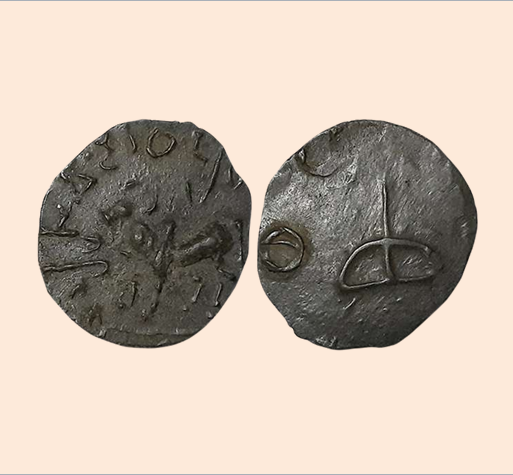
The featured coin is a Potin Unit weighing 1.20 grams, attributed to Rano Visnu Rudra Buddhananda. It belongs to the Bull to Left Type and is catalogued as Pieper #2114. Coins of this ruler are particularly interesting because their legends provide important evidence for the study of the political history of the Banavasi region.
The obverse of the coin depicts a bull standing towards the left, with wavy, river-like lines beneath it. A six-arched hill appears to the left of the bull, while a Brahmi inscription runs around the central design, identifying the issuing ruler as Rano Visnu Rudra Buddhananda. The combination of the bull, water motif and arched hill creates a distinctive composition characteristic of this coin series.
The reverse features an arrangement of bows, arrows and circular motifs. These devices form an interesting combination of geometric and symbolic elements, reflecting the distinctive artistic vocabulary employed in the coinage of the region.
Struck in potin, an alloy commonly encountered in ancient Indian regional coinages, this small denomination is an important example of the monetary practices of early historic Karnataka.
What makes this particular specimen especially desirable is its extremely fine preservation for the type and rarity. The clear details of the bull, six-arched hill and reverse devices make it an appealing example for collectors and students of ancient Indian numismatics.
-
Striking Lead Coin of the Anandas of Banavasi
2026-11-11 WedThe Anandas of Banavasi represent an important chapter in the early historic coinage of Karnataka...
-
Rare Silver Dramma of Aparaditya, Shilaharas of North Konkan
2026-11-10 TueThe Shilaharas were an important ruling dynasty of western India, who governed different regions ...
-
Silver Dramma of Rashtrakuta King Amoghavarsha I
2026-11-10 TueThe Rashtrakutas were among the most powerful imperial dynasties of early medieval India, ruling ...
-
Goddess Lakshmi on a Gold Half Varaha of Harihara II, Vijayanagara Empire
2026-11-06 FriOn the auspicious occasion of Diwali, the festival of lights, prosperity and new beginnings, we c...
-
Celebrating Dhanteras with a Magnificent Gold Dinar of Chandragupta II
2026-11-06 FriDhanteras is traditionally associated with the worship of Goddess Lakshmi, the deity of wealth an...