
2026-11-12 Thu
The Satavahanas were among the most prominent ancient Indian dynasties, ruling large parts of the Deccan and central India from approximately the first century BCE to the third century CE. Their kingdom played a significant role in the political, economic and cultural development of the Indian subcontinent. The dynasty maintained extensive trade networks, encouraged commerce and patronised religious institutions, including Buddhist establishments.
Among the later prominent rulers of this dynasty was Gautamiputra Siri Yajna Satakarni, also known as Yajna Sri Satakarni, who ruled during the late second century CE. He is generally regarded as one of the last major Satavahana rulers. His inscriptions and coins indicate that Satavahana authority continued across substantial parts of the western and eastern Deccan during his reign. His rule is particularly significant for the revival of Satavahana political influence and the continuation of maritime and commercial activities along the western and eastern coasts.
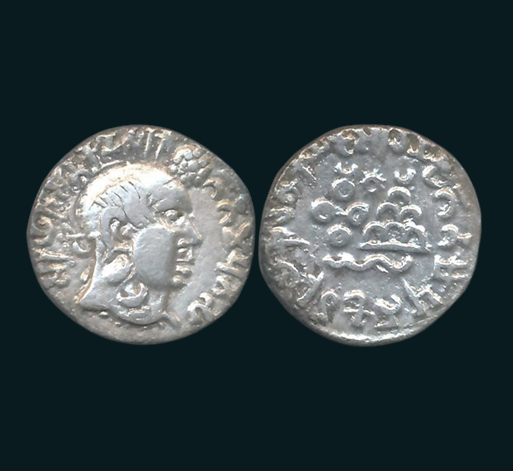
Here, the coin is a silver drachma weighing 2.22 grams, belonging to the portrait type issued by Gautamiputra Siri Yajna Satakarni. These coins are particularly noteworthy for their detailed royal portraiture and distinctive combination of traditional Satavahana symbols.
The obverse features a right-facing bust of the king, displaying long, curly hair, a prominent nose and thick lips. He is depicted wearing an elaborate, high head ornament. Surrounding the portrait is the Brahmi inscription “Siri Yajna Satakanisa Rajno Gotamiputasa”, identifying the issuer as King Gautamiputra Siri Yajna Satakarni. The realistic representation of the ruler makes this coin an important example of portrait-style Satavahana coinage.
The reverse displays an elaborate arrangement of traditional symbols. A four-orb Ujjayini symbol occupies a prominent position alongside a six-arched hill surmounted by a crescent. The Sun symbol appears above, while a flowing river motif is represented below. These elements reflect the distinctive symbolic vocabulary of Satavahana coinage.
The reverse also carries inscriptions in Southern Brahmi, incorporating Tamil-Telugu and Prakrit linguistic traditions. These regional inscriptions are particularly significant as they reflect the linguistic and cultural diversity of the territories under Satavahana influence.
Silver portrait drachmas of Gautamiputra Siri Yajna Satakarni hold considerable numismatic importance. They provide valuable evidence of royal representation, monetary circulation, regional languages and artistic conventions during the later Satavahana period. This coin is a remarkable testament to the dynasty's enduring legacy and the rich numismatic heritage of ancient India.
-
Exploring the Kuras of Kolhapur through Its Coinage
2026-11-12 ThuThe Kuras were among the lesser-known ruling dynasties of ancient India, whose coins provide valu...
-
Anandas of Banavasi – Rano Visnu Rudra Buddhananda, Bull to Left Type
2026-11-11 WedLet us have a look at another fascinating coin from the Anandas of Banavasi, continuing our explo...
-
Striking Lead Coin of the Anandas of Banavasi
2026-11-11 WedThe Anandas of Banavasi represent an important chapter in the early historic coinage of Karnataka...
-
Rare Silver Dramma of Aparaditya, Shilaharas of North Konkan
2026-11-10 TueThe Shilaharas were an important ruling dynasty of western India, who governed different regions ...
-
Silver Dramma of Rashtrakuta King Amoghavarsha I
2026-11-10 TueThe Rashtrakutas were among the most powerful imperial dynasties of early medieval India, ruling ...