
2026-11-13 Fri
The Paramaras were an influential Rajput dynasty that established their power in central India, with their principal kingdom centred on Malwa. Over time, different branches and members of the dynasty extended their influence into neighbouring regions of the Deccan. One such lesser-known branch is associated with Vidarbha, in present-day eastern Maharashtra, which forms an interesting chapter in the political and numismatic history of medieval India.
The Paramaras of Vidarbha are particularly significant because of their distinctive gold coinage, which provides valuable evidence of their political authority and cultural connections with the Deccan. Their coins reflect a combination of Nagari and Kannada-derived symbols, suggesting the interaction of different linguistic and cultural traditions in the region. The attribution of these coins has also been an important subject of numismatic research.
Jagaddeva or Jagadeva was a prominent member of the Paramara family, associated with the Vidarbha region during the 12th century CE. He is identified in numismatic studies as a son of the Paramara ruler Udayaditya of Malwa (c. 1070–1086 CE). Historical and numismatic research has helped establish his association with the Deccan and distinguish his coinage from that of similarly named rulers.
According to numismatic research, Jagaddeva was appointed Mahamandaleshvara of the Kollipaka province by the Western Chalukya ruler Vikramaditya VI (1076–1126 CE). This association indicates the political connections between the Paramaras and the Western Chalukyas. Jagaddeva's gold coins, bearing his name, are important evidence of his authority and provide insight into the monetary practices of the period.
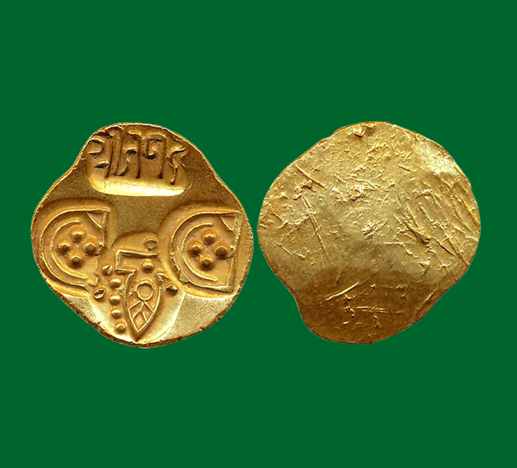
An interesting example of Jagaddeva's coinage is this uniface gold pagoda weighing 3.67 grams. Its obverse features four distinct punches, including the Devanagari legend 'Sri Jagadeva', identifying the issuing ruler. The other symbols include a stylised Old Kannada syllable representing 'Sri', struck twice, and a distinctive linear motif traditionally described as a temple device.
The temple-like motif is particularly intriguing. It consists of a circle with a dot at its centre, interpreted as representing a head, along with two inverted V-shaped elements suggesting the hands and feet. This unusual representation gives the coin a distinctive visual character and has attracted interest among numismatists. The reverse is blank, following the uniface striking tradition.
The use of Devanagari lettering alongside Old Kannada-derived symbols reflects the diverse cultural and linguistic influences that shaped the Deccan during the medieval period. These gold pagodas are important numismatic evidence for understanding Jagaddeva's authority and the monetary traditions of the Paramaras of Vidarbha.
-
Silver Punch-Marked Coin of Vidarbha Janapada – Melghat Region
2026-11-13 FriThe emergence of Janapadas during the ancient period marked an important phase in India's politic...
-
Silver Portrait Drachma of Gautamiputra Siri Yajna Satakarni, Satavahanas
2026-11-12 ThuThe Satavahanas were among the most prominent ancient Indian dynasties, ruling large parts of the...
-
Exploring the Kuras of Kolhapur through Its Coinage
2026-11-12 ThuThe Kuras were among the lesser-known ruling dynasties of ancient India, whose coins provide valu...
-
Anandas of Banavasi – Rano Visnu Rudra Buddhananda, Bull to Left Type
2026-11-11 WedLet us have a look at another fascinating coin from the Anandas of Banavasi, continuing our explo...
-
Striking Lead Coin of the Anandas of Banavasi
2026-11-11 WedThe Anandas of Banavasi represent an important chapter in the early historic coinage of Karnataka...