
2026-10-13 Tue
The Hoysalas were a prominent medieval South Indian dynasty that ruled large parts of present-day Karnataka and extended their influence into neighbouring regions between the 10th and 14th centuries CE. Originally associated with the Malnad region of the Western Ghats, the dynasty gradually emerged as a major political power in the Deccan and southern India.
The Hoysala capital was initially located at Belur before shifting to Dwarasamudra. Under rulers such as Vishnuvardhana (c. 1108–1152 CE), Veera Ballala II (c. 1173–1220 CE) and Veera Ballala III (c. 1292–1343 CE), the kingdom expanded its political influence and developed a distinctive cultural identity.
The Hoysalas are particularly celebrated for their contributions to temple architecture, sculpture, literature and religion. The magnificent temples at Belur, Halebidu and Somanathapura showcase their artistic achievements, with intricate stone carvings depicting deities, mythological narratives, dancers and scenes from everyday life.
The dynasty's history is also reflected in its coinage, which offers valuable evidence of its religious traditions, royal symbols and monetary practices. They issued coins primarily in gold, alongside smaller quantities of silver and copper.
Among the principal gold denominations were the gadyana, also known as the honnu, and the smaller fanam. The gadyana was a heavier gold coin, while the fanam served as a smaller denomination suitable for transactions requiring lower values. Fractional denominations were also produced.
Their coins are notable for their religious imagery and distinctive symbols. Their designs include stylised lions or shardulas, boars, deities and other mythological figures. Some coins also bear legends in Old Kannada, recording royal titles and associations with particular rulers.
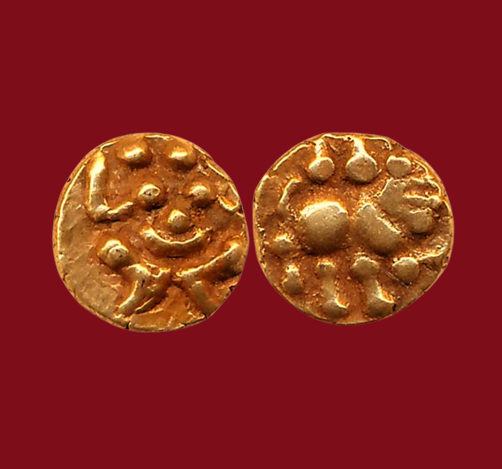
This small gold fanam is an intriguing example of Hoysala coinage, combining religious imagery with an animal motif associated with strength and authority. Weighing just 0.41 grams, the coin demonstrates how the artistic and religious traditions of medieval South India were represented on compact gold currency.
Here, the obverse of the coin features a seated goddess, a motif that reflects the importance of divine figures in the visual language of Indian coinage. The reverse depicts a lion facing right. Lions and stylised lion-like creatures, commonly identified as shardulas in Hoysala numismatic descriptions, appear on several varieties of Hoysala coins.
-
Seated Divine Couple on a Copper Kasu of the Nayakas of Madurai
2026-10-13 TueOn the third day of Navaratri, we celebrate the divine feminine power, or Shakti, and pay tribute...
-
A Seated Goddess on a Vijayanagara Copper Coin
2026-10-12 MonNavratri is a festival dedicated to the worship of the Divine Mother, celebrated in different for...
-
A Divine Tribute to Goddess Chamundi: Krishna Raja Wodeyar’s Silver Pavali
2026-10-12 MonOn the second day of Navratri, let us pay tribute to Devi Maa through a remarkable silver coin of...
-
Bow and Arrow on an Ancient Chera Copper Coin of the Sangam Age
2026-10-09 FriIn our ongoing series exploring the coinage of the Sangam Age, this uninscribed copper coin attri...
-
Symbolic Motifs on an Ancient Chola Copper Coin of the Sangam Age
2026-10-09 FriThe Chola dynasty was one of the three great ruling houses of ancient Tamilakam, alongside the Ch...