
2026-10-12 Mon
Navratri is a festival dedicated to the worship of the Divine Mother, celebrated in different forms and traditions throughout India. The Goddess represents Shakti—the creative, protective and transformative power of the universe. During these nine nights, devotees honour her many manifestations and celebrate the triumph of good over evil.
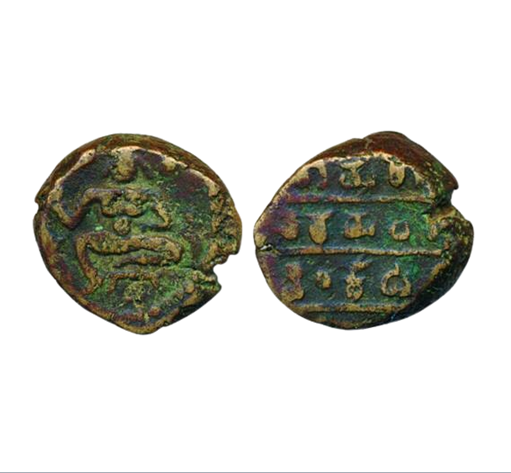
As the sacred festival of Navratri continues, we turn our attention to a remarkable copper coin from the Vijayanagara tradition, featuring a seated Goddess on its obverse and a Tamil legend on its reverse. Through its religious imagery and regional script, this coin offers a glimpse into the rich numismatic heritage of southern India and provides a fitting occasion to celebrate the divine feminine power worshipped during Navratri.
The Vijayanagara Empire was founded in 1336 CE by Harihara I and Bukka Raya I. Centred initially at Vijayanagara, near present-day Hampi in Karnataka; the empire grew into one of the most influential political and cultural powers in medieval southern India. Under successive dynasties, including the Sangama, Saluva, Tuluva and Aravidu, Vijayanagara rulers extended their authority across extensive parts of southern India.
The empire became renowned for its monumental temples, distinctive architecture, flourishing trade and patronage of literature, music and the arts. Religious traditions played an important role in royal life, and this influence is reflected in the empire's coinage, which featured Hindu deities alongside royal names, titles and dynastic symbols.
Vijayanagara coins were issued in gold, silver and copper, serving different monetary purposes. Gold pagodas were especially prominent, while copper coins circulated in everyday transactions. The designs included figures of Lakshmi, Vishnu, Shiva, Parvati and other deities, demonstrating the close relationship between religious iconography and the visual language of royal authority.
The featured coin weighs 9.69 grams and is made of copper. The obverse depicts a Goddess seated on a throne. Her left hand rests over her waist, while her right hand is raised upwards. The frontal presentation gives the figure a commanding presence, while the throne emphasises the deity's elevated status. The reverse bears a legend in the Tamil script, linking the coin with the linguistic and cultural traditions of southern India.
Nevertheless, the image reflects the importance of divine figures in the artistic vocabulary of southern Indian coinage. Such representations connected religious belief with everyday material culture, allowing sacred imagery to circulate beyond temples and royal ceremonies.
Regional scripts on coins are valuable evidence for numismatists. They can help establish relationships between a coin and the communities, territories and monetary practices associated with its circulation. However, because the precise inscription has not been provided, its reading and the issuing ruler cannot be confirmed here.
The combination of a religious figure on one side and a regional inscription on the other illustrates how coin designs could bring together devotional imagery and local identity.
-
A Divine Tribute to Goddess Chamundi: Krishna Raja Wodeyar’s Silver Pavali
2026-10-12 MonOn the second day of Navratri, let us pay tribute to Devi Maa through a remarkable silver coin of...
-
Bow and Arrow on an Ancient Chera Copper Coin of the Sangam Age
2026-10-09 FriIn our ongoing series exploring the coinage of the Sangam Age, this uninscribed copper coin attri...
-
Symbolic Motifs on an Ancient Chola Copper Coin of the Sangam Age
2026-10-09 FriThe Chola dynasty was one of the three great ruling houses of ancient Tamilakam, alongside the Ch...
-
Iconography of Chera Dynasty on a Square Copper Coin
2026-10-08 ThuThe Cheras were one of the three great crowned dynasties of ancient Tamilakam, alongside the Chol...
-
Decoding the Symbols of a Sangam Age Pandyan Copper Coin
2026-10-08 ThuThe Sangam age is generally placed broadly between c. 300 BCE and 300 CE, although the chronology...