
2026-10-09 Fri
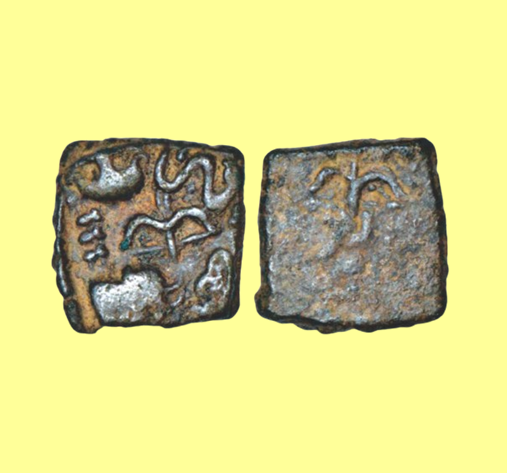
In our ongoing series exploring the coinage of the Sangam Age, this uninscribed copper coin attributed to the Chera dynasty stands out for its combination of animal imagery, weapons, and other distinctive symbols. The bow and arrow, a well-known emblem associated with the Cheras, is particularly significant in the study of their coinage.
The obverse presents a symbolic arrangement centred on an elephant facing right, with an arched hill positioned to its right. A strung bow and arrow appear above the main design, while a fish is depicted to the elephant's left. At the top of the composition are a wavy line and a battle-axe.
The elephant is a recurring motif in ancient Indian art and coinage, often associated with power, prestige, and the natural environment. The arched hill adds another distinctive element to the design, while the fish and battle-axe contribute to the varied symbolic vocabulary of the coin. The wavy line may represent a natural feature such as water, although its precise significance on this specimen cannot be established with certainty.
Of particular interest is the strung bow and arrow, an emblem closely associated with the Chera dynasty. Its placement above the principal motifs reinforces the coin's attribution and provides an important point of comparison with other known Chera coin types. The presence of several symbols on a single coin also illustrates the complex visual language employed in early South Indian monetary traditions.
The reverse features a strung bow and arrow, presented as the principal design. The prominence of this emblem is significant because the bow was traditionally associated with the Cheras and appears in representations of their dynastic identity.
The relatively simple reverse contrasts with the more elaborate symbolic composition on the obverse. This arrangement places emphasis on the bow and arrow, making it the defining feature of the coin's reverse design.
-
Symbolic Motifs on an Ancient Chola Copper Coin of the Sangam Age
2026-10-09 FriThe Chola dynasty was one of the three great ruling houses of ancient Tamilakam, alongside the Ch...
-
Iconography of Chera Dynasty on a Square Copper Coin
2026-10-08 ThuThe Cheras were one of the three great crowned dynasties of ancient Tamilakam, alongside the Chol...
-
Decoding the Symbols of a Sangam Age Pandyan Copper Coin
2026-10-08 ThuThe Sangam age is generally placed broadly between c. 300 BCE and 300 CE, although the chronology...
-
Royal Emblems on a Gold Kahavanu of Rajendra Chola
2026-10-07 WedRajendra Chola I (1012–1044 AD) was one of the most powerful rulers of the Chola dynasty and th...
-
Parasu-Type Copper Coin of Venad Cheras
2026-10-07 WedThe Venad Cheras formed an important branch of the medieval Chera tradition in the southern part ...