
2026-10-09 Fri
The Chola dynasty was one of the three great ruling houses of ancient Tamilakam, alongside the Cheras and Pandyas. The early Cholas are known through Sangam literature, inscriptions, and archaeological and numismatic evidence, which together offer insights into the political, cultural, and economic life of ancient southern India. The Kaveri river basin formed the heartland of Chola power, with Uraiyur remembered as an important early centre. The region's fertile agricultural landscape and connections with inland and maritime trade contributed to its historical significance.
In this ongoing series exploring the coinage of the Sangam Age, the present specimen offers an intriguing combination of symbols and animal imagery associated with early South Indian numismatics.
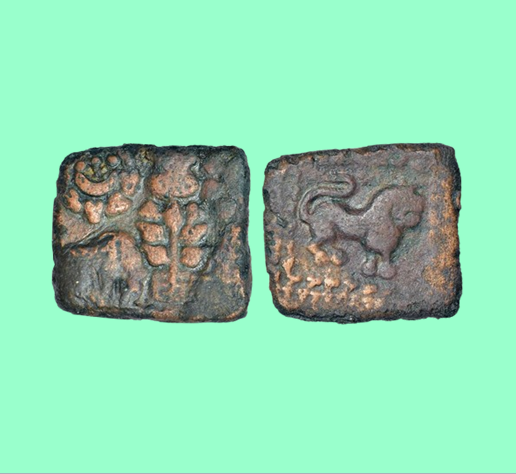
The obverse features a distinctive arrangement of symbols. At the centre is a tree within a railing, flanked by an elephant facing right on the left and an arched hill on the right. Above the tree appears the Shrivatsa symbol. A crescent accompanied by taurines occupies the upper-left area, while a six-armed symbol appears to the right.
The composition brings together motifs frequently encountered in early Indian coinage, including trees enclosed within railings, elephants, hills, and abstract geometric symbols. Such imagery provides valuable material for studying the symbolic vocabulary of early South Indian monetary traditions. Although individual motifs may have religious, cultural, or political associations, their precise meanings on this particular coin remain uncertain.
The reverse depicts a lion facing right with its tail raised, enclosed within a double ornamental border composed of taurines and a rayed rectangle. The animal occupies the central field, while the surrounding decorative elements frame the design.
The lion is a prominent motif in ancient Indian art and symbolism, appearing in a variety of religious, political, and artistic contexts. On this specimen, its dynamic posture and the elaborate border create a visually distinctive composition. The combination of animal imagery and geometric ornamentation also illustrates the variety of designs found on early uninscribed copper coinage.
-
Bow and Arrow on an Ancient Chera Copper Coin of the Sangam Age
2026-10-09 FriIn our ongoing series exploring the coinage of the Sangam Age, this uninscribed copper coin attri...
-
Iconography of Chera Dynasty on a Square Copper Coin
2026-10-08 ThuThe Cheras were one of the three great crowned dynasties of ancient Tamilakam, alongside the Chol...
-
Decoding the Symbols of a Sangam Age Pandyan Copper Coin
2026-10-08 ThuThe Sangam age is generally placed broadly between c. 300 BCE and 300 CE, although the chronology...
-
Royal Emblems on a Gold Kahavanu of Rajendra Chola
2026-10-07 WedRajendra Chola I (1012–1044 AD) was one of the most powerful rulers of the Chola dynasty and th...
-
Parasu-Type Copper Coin of Venad Cheras
2026-10-07 WedThe Venad Cheras formed an important branch of the medieval Chera tradition in the southern part ...