
2026-06-17 Wed
The Madras Presidency was one of the three major administrative subdivisions of East India Company. It covered much of southern India, Tamil Nadu, Andhra Pradesh, parts of Kerala, Karnataka, Odisha, and Telangana. It served as an important base for trade and other administration in the region.
The coinage of the Madras Presidency under the East India Company (EIC) was among the earliest issued coins in India, beginning in the 1670s. Principal of Numismatic continuity is reflected in the coinage as the coins of erstwhile rulers' motifs and weight standards were continued.
In higher denominations, gold Double Pagodas, Pagodas (equivalent to 3 1/2 Rupees) carried image of Lord Vishnu on Obverse and Granulated pattern on reverse. Mohurs, Silver Double Rupees, rupees, 1/2 rupees, 1/4 rupees, and 1/8 rupee continued to be minted in general standards using persian script. Later 1/4 Pagodas, and Half Pagodas were minted in Silver depicting Lord Vishnu and Gopuram on Obverse and reverse respectively. Silver Two fanams, Fanams (Sanskrit Panas) were continued to be minted in South Indian style depicting deities, primarily Lord Vishnu and local motifs. Later the fanams with Belt and multiple scripts were also minted in large numbers. The lower denominations in copper were 40, 20, and 10 Cash were minted. The principal mints were located at Madras or Fort St. George, Arcot, and Machilipatnam.
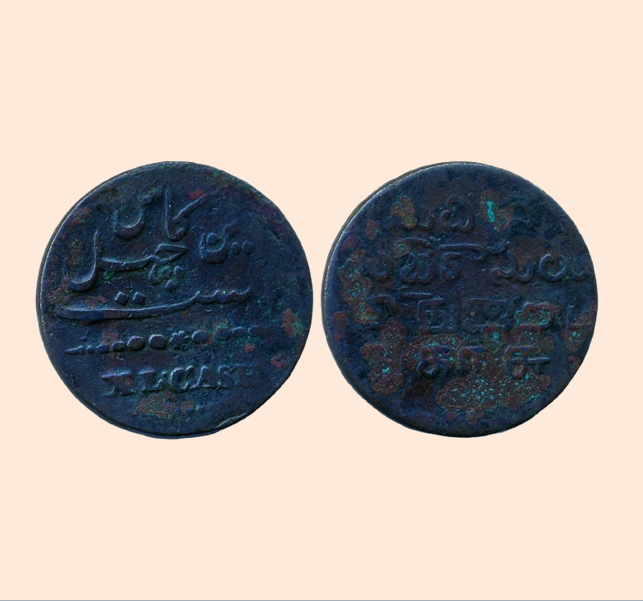
Copper Cash carried multiple scripts, mainly Persian and Roman script. However, 1807 onwards the copper cash carried multiple script adding two more scripts - Telugu and Tamil. The above 40 Cash is a large copper coin issued by the East India Company for the Madras Presidency in 1807–1810s series. The coin weighs 19.34 grams and was struck at the Madras Mint. The obverse depicts the value in Persian script “In chahal kas ast”, with the English legend “XL CASH” below.
The reverse displays the value in two South Indian languages i.e., Telugu: “Idi nalabhai kasulu” and Tamil: “Idu naipadu kasu”.
Term 'Cash' on the coin is derived from Tamil Kasu, a tadbhav word derived from Karshapana
-
The Elephant on an Indo-Greek Silver Drachm of Apollodotus I
2026-09-22 TueElephants were not just an important part of Indian heritage and religious traditions; they also ...
-
Gajalakshmi Flanked by Elephants on a Post-Mauryan Ujjaini Copper Coin
2026-09-22 TueThe association between Gajalakshmi and elephants is one of the most enduring motifs in Indian re...
-
Elephant Head on a Bronze Coin of Indo-Scythian King Maues
2026-09-21 MonAs the eighth day of Ganesh Utsav is celebrated, the elephant once again provides a fascinating l...
-
A Remarkable Elephant-and-Lion Standard on Vrishni Coinage
2026-09-21 MonAs Ganesh Utsav continues, the elephant once again offers a fascinating doorway into India’s an...
-
Elephant and Lion on a Cooch Behar Royal Coin
2026-09-19 SatThe elephant occupies a distinctive place in the cultural traditions of eastern India, particular...