
2026-06-17 Wed
The East India Company (EIC) established trading posts in the Mughal Bengal Subah in the early 1600s. In 1690, Job Charnock founded a factory in the villages of Sutanuti, Gobindapur, and Kalikata on the banks of the Hooghly River. These settlements eventually grew into the city of Calcutta.
Fort William was constructed around 1696–1700 and became the administrative seat of the Bengal Presidency around 1700. It was one of the three major presidencies of EIC. Bengal quickly emerged as the most lucrative due to its rich agriculture, thriving textile industry, and strategic trade networks.
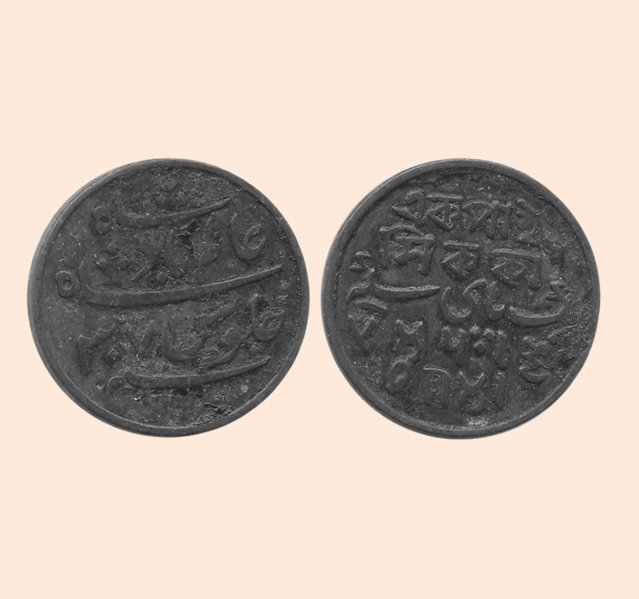
Bengal Presidency hammered silver coins were minted with persian script in the name of nominal Shah Alam II. Important mints included Alinagar Kalkatah (Calcutta), Azimabad (Patna), Banaras (Varanasi), Jahangirnagar (Dacca), and Murshidabad.
The monetary system followed 3 pies eqvivalent to 1 Pice (paisa), 6 paisa = Anna, 16 Anna = 1 Rupee system. The copper coins were minted in the denominations of 1/2 Pice, Pice, 2 Pice, 1/2 Anna. The silver denominatins started from lowest denomination of 1/16 rupee.The obverse of the above copper coin weighing 6.30g features Persian legend Sanah Julus Shah Alam Badshah, with the regnal year (RY) 37. The reverse displays the value in trilingual inscriptions i.e., Bengali on top, Persian in middle, Devanagari at bottom, typically reading “Ek Pai Sikka” or “One Pice".
-
The Elephant on an Indo-Greek Silver Drachm of Apollodotus I
2026-09-22 TueElephants were not just an important part of Indian heritage and religious traditions; they also ...
-
Gajalakshmi Flanked by Elephants on a Post-Mauryan Ujjaini Copper Coin
2026-09-22 TueThe association between Gajalakshmi and elephants is one of the most enduring motifs in Indian re...
-
Elephant Head on a Bronze Coin of Indo-Scythian King Maues
2026-09-21 MonAs the eighth day of Ganesh Utsav is celebrated, the elephant once again provides a fascinating l...
-
A Remarkable Elephant-and-Lion Standard on Vrishni Coinage
2026-09-21 MonAs Ganesh Utsav continues, the elephant once again offers a fascinating doorway into India’s an...
-
Elephant and Lion on a Cooch Behar Royal Coin
2026-09-19 SatThe elephant occupies a distinctive place in the cultural traditions of eastern India, particular...