
2026-06-16 Tue
The Mysore (Mahisuru) Kingdom was a major and important South Indian kingdom that was ruled by various Hindu dynasties till 1761. For a brief period the region was under Hyder/Tipu. Thereafter, Wadiyars(Wodeyar) became the rulers of Mysore and played a significant role in the history of Karnataka and southern India.
Krishnaraja Wodeyar III was the 22nd Maharaja of Mysore. Born on 14th July 1794 in Srirangapatna, he ascended the throne at age 5 in 1799 after the British defeated Tipu Sultan in the Fourth Anglo-Mysore War. His rule lasted nearly 69 years, the longest among Wadiyar rulers. From 1810 onwards, he attained the "age of discretion" and took direct and full control of the kingdom.
He is remembered as a cultural founder of modern Mysore as he was great patron of arts, literature, and culture. He Revived and supported Mysore-style painting, portraiture, and murals. Established the foundation for what became the Jaganmohan Palace Art Gallery.
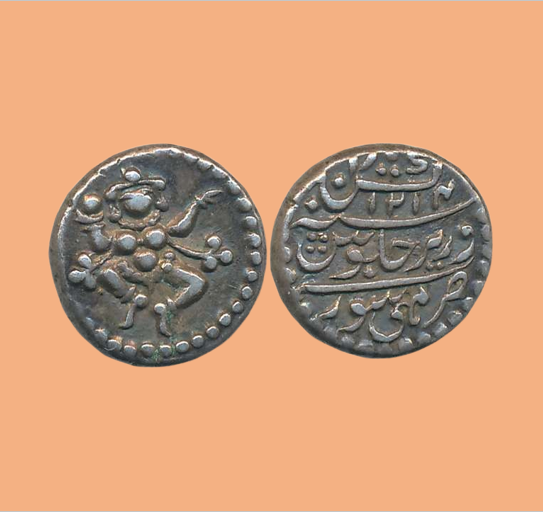
The above coin is known as Chamundi pavli. The coin reflects the deep religious devotion of the Wodeyar rulers to Goddess Chamundi, who is famously revered for defeating the buffalo demon Mahishasura atop the Chamundi Hills in Mysuru. Today, these coins are considered valuable historical artifacts of Karnataka's monetary history.
This ¼ Rupee or Pavli of Krishnaraja of Wodeyar depicts the dancing figure Chamundi on the obverse while the reverse features persian legends and mint name Mahisur at bottom. The persian script was used on the coins during the period for monetary relevance with East India Company [EIC] coinage. EIC used persian script on their coinage in all three presidencies.
-
The Elephant on an Indo-Greek Silver Drachm of Apollodotus I
2026-09-22 TueElephants were not just an important part of Indian heritage and religious traditions; they also ...
-
Gajalakshmi Flanked by Elephants on a Post-Mauryan Ujjaini Copper Coin
2026-09-22 TueThe association between Gajalakshmi and elephants is one of the most enduring motifs in Indian re...
-
Elephant Head on a Bronze Coin of Indo-Scythian King Maues
2026-09-21 MonAs the eighth day of Ganesh Utsav is celebrated, the elephant once again provides a fascinating l...
-
A Remarkable Elephant-and-Lion Standard on Vrishni Coinage
2026-09-21 MonAs Ganesh Utsav continues, the elephant once again offers a fascinating doorway into India’s an...
-
Elephant and Lion on a Cooch Behar Royal Coin
2026-09-19 SatThe elephant occupies a distinctive place in the cultural traditions of eastern India, particular...