
Greek And Roman Deities On Coins-31
2026-02-18 Wed
During the ancient period, the term 'Baal' or 'Ba?al' referred to a title and an honorific meaning 'owner' or '#LORD' in the North West Semitic languages COMMON in the Levant. This region includes parts of what are now Turkey, Syria, Lebanon, Palestine, Jordan, Israel, Cyprus, and Egypt. Initially used for people, the term later became linked with gods, especially as Baal began to represent #rain, lightning, #wind, fertility, and kingship.images of Baal started appearing on Coins around the 4th century BCE. One notable area for minting coins with Baal's image was Babylon. Located in present-day Iraq, Babylon came under the control of Alexander of Macedonia in 331 BCE. This event marked the beginning of significant Greek influence in the area, which later became part of the Hellenistic Seleucid Empire. To ensure numismatic continuity, silver coins from this time displayed local symbols rather than unfamiliar Macedonian figures, which may not have been recognized by Babylonian elites, temple institutions, and regional #trading networks.
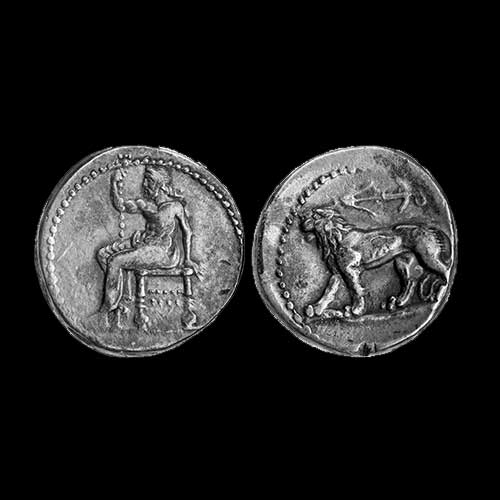
The COIN shown in this post is a Silver Stater from 311 BCE to 305 BCE, issued by Seleucus I Nicator in Babylon. It has a dia of 23 mm and weighs 15.65 grams. The obverse features Baal seated to the left, holding a scepter in his right hand and resting his left hand on the #Throne. The reverse displays a LION walking to the left, with an anchor above it.
Seleucus I Nicator was a Macedonian Greek general and the successor to Alexander of Macedonia in Persia. He founded the Seleucid dynasty, which included areas of modern Afghanistan, Iran, Iraq, Syria, and Lebanon, as well as parts of Turkey, Armenia, Turkmenistan, Uzbekistan, and Tajikistan. Between 305 and 303 BCE, a conflict arose between Seleucus I Nicator and Chandragupta Maurya. The Mauryan Empire eventually defeated the Seleucid Empire, securing large territories in present-day Afghanistan and Pakistan.
Latest News
-
The Elephant on an Indo-Greek Silver Drachm of Apollodotus I
2026-09-22 TueElephants were not just an important part of Indian heritage and religious traditions; they also ...
-
Gajalakshmi Flanked by Elephants on a Post-Mauryan Ujjaini Copper Coin
2026-09-22 TueThe association between Gajalakshmi and elephants is one of the most enduring motifs in Indian re...
-
Elephant Head on a Bronze Coin of Indo-Scythian King Maues
2026-09-21 MonAs the eighth day of Ganesh Utsav is celebrated, the elephant once again provides a fascinating l...
-
A Remarkable Elephant-and-Lion Standard on Vrishni Coinage
2026-09-21 MonAs Ganesh Utsav continues, the elephant once again offers a fascinating doorway into India’s an...
-
Elephant and Lion on a Cooch Behar Royal Coin
2026-09-19 SatThe elephant occupies a distinctive place in the cultural traditions of eastern India, particular...