
Fascinating Archaeological Facts on Postage Stamps - 78
2025-07-25 Fri
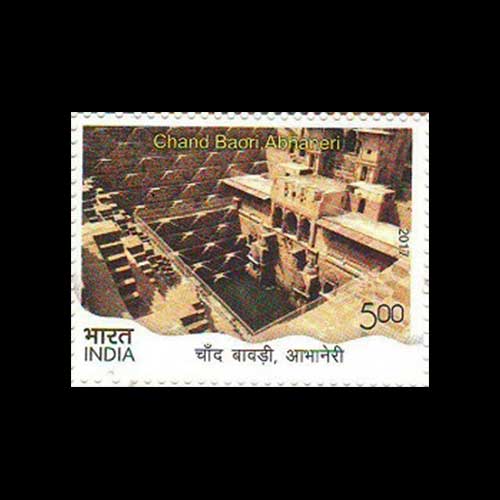
Step wells are one of the most unique and least known aspects of Indian architecture. These structures were excavated to access underground water sources and are referred to by various names, including ‘bawdi’, ‘baoli’, ‘vav’, ‘vavdi’, ‘vai’, ‘kalyani’, or ‘pushkarni’. Historical texts like the Silpa-Shastras and ancient inscriptions, denote them as ‘Vapi’ or ‘Vapika’. Primarily, step wells served religious and ceremonial purposes in addition to providing essential water supplies.Among the most notable step wells is Chand Baori, located in the village of Abhaneri, Rajasthan. Recognized as one of the oldest and deepest step wells globally, it was constructed between the 8th and 9th centuries CE by King Chand of the Nikumbh dynasty. Renowned for its architectural grandeur, Chand Baori features 13 levels and approximately 3,500 narrow steps, making it one of the largest step wells in India.
According to the characteristics outlined in the Aparajitapriccha, a 12th-century Sanskrit treatise on architecture and arts, Chand Baori is classified as a vijaya-vapi, or “step well of victory.” Constructed from #GREY sandstone sourced from the Alwar district, it showcases exquisite #craftsmanship.
Morna Livingston, in her work "Steps to Water: The #ancient Stepwells of India" (2002), notes that ancient shrines dedicated to Mahishasuramardini and Ganesha is positioned near the base of the well. Additionally the upper levels were renovated into a palace by the Mughals in the 18th century.
The site also features the Harshatmata Temple, which dates back to the 9th century. In the 19th century, james Tod documented the remnants of this significant structure in the #Village of Abhaneri. While only a few sculptures remain in their original locations at the temple, the bulk of the recovered sculptures are housed in an enclosure at Chand Baori.
On 29 December 2017, India Post issued a set of 16 #Stamps and a miniature sheet featuring the Step wells of India. One among them is the Chand Baori for a face value of Rs. 5. For more insights on this series refer to : This Post
Latest News
-
The Elephant on an Indo-Greek Silver Drachm of Apollodotus I
2026-09-22 TueElephants were not just an important part of Indian heritage and religious traditions; they also ...
-
Gajalakshmi Flanked by Elephants on a Post-Mauryan Ujjaini Copper Coin
2026-09-22 TueThe association between Gajalakshmi and elephants is one of the most enduring motifs in Indian re...
-
Elephant Head on a Bronze Coin of Indo-Scythian King Maues
2026-09-21 MonAs the eighth day of Ganesh Utsav is celebrated, the elephant once again provides a fascinating l...
-
A Remarkable Elephant-and-Lion Standard on Vrishni Coinage
2026-09-21 MonAs Ganesh Utsav continues, the elephant once again offers a fascinating doorway into India’s an...
-
Elephant and Lion on a Cooch Behar Royal Coin
2026-09-19 SatThe elephant occupies a distinctive place in the cultural traditions of eastern India, particular...