
Fascinating Archaeological Facts on Postage Stamps - 71
2025-07-11 Fri
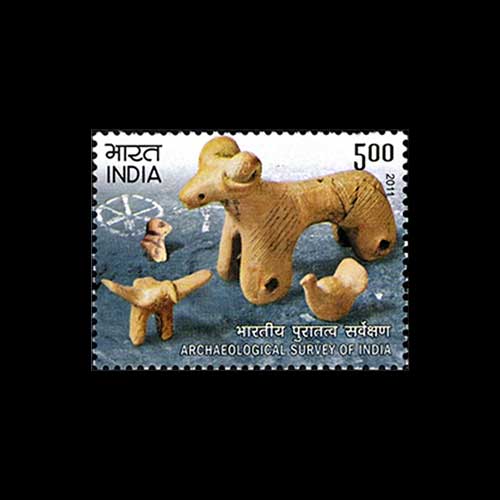
Toys serve as an integral component of childhood, significantly contributing to the development of a child’s personality and character. In her work, ‘The Forgotten: An Approach on Harappan Toy Artefacts (2006)’, Elke Rogersdotter discusses how in the archaeological discoveries, objects are interpreted as toys, when being quite common, when not being particularly elaborately styled as well as when found scattered all around the settlement. Archaeological evidence indicates that clay was a widely used medium for toy construction in ancient times.The Harappan civilization is distinguished by its advancements in technology, art, and craftsmanship. Numerous toy materials from the Harappan period have been unearthed in proximity to settlements. Various artifacts, including a diverse range of figurines and miniature carts primarily made from terracotta, are frequently documented as toys of Harappan culture by archaeologists. In addition to terracotta, other materials employed in toy manufacturing include faience, stones, Shell, copper, and #Bronze. Among the terracotta toy artifacts, animal and bird figurines represent the most prevalent category, followed closely by toy cart frames.
In ‘Terracotta Toy Artefacts of Harappan Culture: A Medium of Learning for Children (2017)’, researchers Suruchika Chawla and Ambika Patel highlight that the presence of animal figurines is a consistent attribute in major urban centers of the Harappan Civilization. These figurines portray both domestic and wild animals, including Bulls, dogs, Horses, Rams, pigs, and rhinoceroses. Certain figurines featured movable heads and openings for wheel attachment, indicating their function as toys.
Furthermore, additional creatures such as squirrels, monkeys, parrots, ducks, snakes, mongooses, and tortoises were crafted in a realistic manner and occasionally adorned with Colors. These artifact categories reflect the diversity of the fauna observed during that period, which the Harappans skillfully replicated in clay.
Residing on the flat alluvial plains, the Harappans innovated various two-wheeled cart designs, some of which have survived as Clay toys. Certain terracotta toy carts exhibit solid floors and sidebars, while others feature hollow frames with openings for removable sidings.
Additional categories of toys include terracotta rattles, whistles, wheels, miniature vessels, toy cages, and figurines representing men and women. gaming artifacts consist of Dice, board games and gamesmen.
On 20 December 2011, India Post issued a set of two Stamps and a miniature sheet to commemorate the 150th anniversary of the Archaeological Survey of India (ASI). Notably, one of these stamps highlights Harappan toys and is valued at Rs 5. For further information about the ASI, please refer to This Post
It would not be improper to mention that recently India's toy exports have seen significant Growth. A big shift from being a net importer to a net exporter. The Indian government has implemented measures like the National action Plan for Toys (NAPT) to further boost the industry and promote India as a global toy hub.
Latest News
-
The Elephant on an Indo-Greek Silver Drachm of Apollodotus I
2026-09-22 TueElephants were not just an important part of Indian heritage and religious traditions; they also ...
-
Gajalakshmi Flanked by Elephants on a Post-Mauryan Ujjaini Copper Coin
2026-09-22 TueThe association between Gajalakshmi and elephants is one of the most enduring motifs in Indian re...
-
Elephant Head on a Bronze Coin of Indo-Scythian King Maues
2026-09-21 MonAs the eighth day of Ganesh Utsav is celebrated, the elephant once again provides a fascinating l...
-
A Remarkable Elephant-and-Lion Standard on Vrishni Coinage
2026-09-21 MonAs Ganesh Utsav continues, the elephant once again offers a fascinating doorway into India’s an...
-
Elephant and Lion on a Cooch Behar Royal Coin
2026-09-19 SatThe elephant occupies a distinctive place in the cultural traditions of eastern India, particular...