
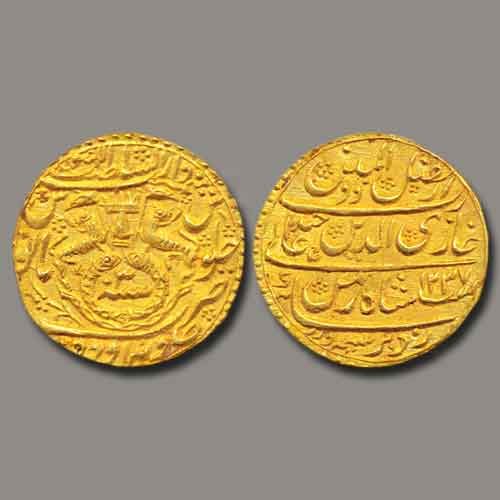
Gold Ashrafi of Awadh
2017-12-05 Tue
The Political unity of Awadh can be traced back to the ancient Hindu kingdom of Kosala, with the Ayodhya as its capital. In the medieval times, Awadh is mentioned during the reign of Mughal Emperor Akbar the Great. In the British historical text, it is mention as ‘Audh’ or ‘Oudh’. The region is located in the Indian states of Uttar Pradesh.The Nawabs of this state traced their origin to ‘Muhammad Amin’, a Persian adventurer who served the Mughal Emperor, 'Muhammad Shah’. Muhammad Amin was appointed as the Subahdar of Awadh in 1720 AD. In the later period, Awadh declared its independence due towards the decline of the Mughal Empire.
This gold Ashrafi was issued by Ghazi-ud-din Haider during the 3rd year of his reign, in the year AH 1237. The obverse of the coin is inscribed with the Awadh Coat of Arms and reverse of the coin is inscribed with the name and title of the king.
Latest News
-
Bow and Arrow on an Ancient Chera Copper Coin of the Sangam Age
2026-10-09 FriIn our ongoing series exploring the coinage of the Sangam Age, this uninscribed copper coin attri...
-
Symbolic Motifs on an Ancient Chola Copper Coin of the Sangam Age
2026-10-09 FriThe Chola dynasty was one of the three great ruling houses of ancient Tamilakam, alongside the Ch...
-
Iconography of Chera Dynasty on a Square Copper Coin
2026-10-08 ThuThe Cheras were one of the three great crowned dynasties of ancient Tamilakam, alongside the Chol...
-
Decoding the Symbols of a Sangam Age Pandyan Copper Coin
2026-10-08 ThuThe Sangam age is generally placed broadly between c. 300 BCE and 300 CE, although the chronology...
-
Royal Emblems on a Gold Kahavanu of Rajendra Chola
2026-10-07 WedRajendra Chola I (1012–1044 AD) was one of the most powerful rulers of the Chola dynasty and th...