
2026-08-10 Mon
Baroda was one of the largest, wealthiest, and most progressive princely states in British India. It was founded in 1721 when the Maratha general Pilaji Rao Gaekwad seized Songadh from the Mughals and established Gaekwad power in Gujarat. The Gaekwad dynasty, whose name derives from “cowherd,” rose from military service under the Maratha Peshwas to independent rule.
The capital, Baroda, developed into a modern city with railways, banks, educational institutions, and industry. Its prosperity rested on fertile agriculture, cotton, and trade. Under the long and enlightened reign of Maharaja Sayajirao Gaekwad III, Baroda became a model of progressive administration with free and compulsory primary education (pioneered in 1906), social reforms, public libraries, museums and the Bank of Baroda (1908).
Maharaja Pratap Singh Gaekwad (1908–1968) was the last ruling Maharaja of Baroda. Ruling from 1939 until the state’s merger in 1949, he is remembered as the “soldier king” and “polo prince.” He founded the Maharaja Sayajirao University of Baroda in 1949 and establishing the Sir Sayajirao Diamond Jubilee and Memorial Trust to support education. He introduced higher-education scholarships for women, enacted minimum-wage provisions for matriculates, and established the Baroda Medical College.
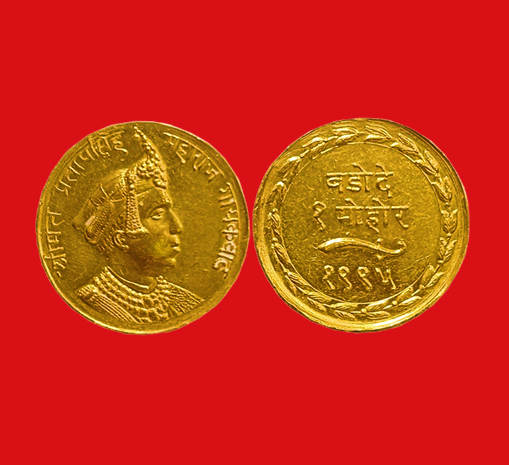
Pratap SinghBaroda’s coinage named the Mughal emperor with Gaekwad marks such as the scimitar or Nagari initials to distinctive state issues. Pratap Singh issued coronation or accession-related Mohurs dated VS 1995. These were special, high-quality milled pieces rather than circulating currency, reflecting both royal prestige and the ceremonial traditions of late princely India. They are scarce and highly regarded by collectors of Indian princely-state gold.
This particular gold Mohur weighs 5.81 grams and is dated Vikram Samvat 1995 (1938–39 CE). The obverse of the coin depicts a finely detailed bust of Maharaja Pratap Singh facing right, wearing a royal headdress with ornaments. Surrounding it is the Devanagari legend “Srimant Pratap Singh Maharaj Gayakwad”.
The reverse features name of the state “Baroda,” the denomination, and the date VS 1995, typically arranged with a scimitar (the Gaekwad dynastic emblem) and enclosed within a wreath or decorative border.
This elegant gold Mohur thus encapsulates the grandeur of Baroda, the progressive yet transitional reign of its last ruling Maharaja, and the refined numismatic tradition of the Gaekwads.
-
Lakshman Singh’s Gold Nazarana Mohur of Dungarpur
2026-08-10 Mon -
Nanaia Type Copper Coin of Emperor Kanishka I, Kushan
2026-08-07 Fri -
Lanky Bull/ Nandi Type Copper Unit of Kaushambi City State
2026-08-07 Fri -
Silver Rupee of Progressive Baroda’s Maharaja Sayajirao Gaekwad III
2026-08-06 Thu -
Golden Jubilee – Silver Nazarana Rupee of Maharaja Ganga Singh, Bikaner State
2026-08-06 Thu