
This Gold Gadyana of Western Chalukyas Explains the Prominence of Shaivism from 9th to 12th Century CE
2017-10-27 Fri
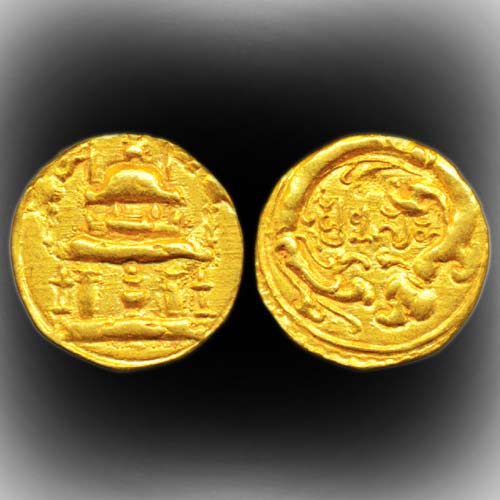
The Western Chalukya Empire, also known as the Kalyani Chalukya, ruled western Deccan and southern India between the 10th and 12th centuries CE.The above shown gold Gadyana belongs to either western Chalukyas or Feudatories. The obverse of this coin depicts Shaivite temple with architectural features like pillars, Vimana and Shikhara. Two banners and two temple-lamps are flanking above it within the line and dotted border.
The reverse of this coin depicts a floral scroll emanating out from a Sankha shell with Hale-Kannada inscription in the centre which starts with word ‘Punya’ within the line and dotted border. Shaivism dominated the political environment from 9th to 12th century CE in India. Its influence can be seen on coins by the choice of the depiction of a Shaivite temple.
Sankha illustrated on the reverse of this coin is also associated with generosity and abundance of resources. The legend of this coin is assumed to be a merit associated with the issuer who helped to build this temple.
To know more about Chalukya coin click here
Latest News
-
Bow and Arrow on an Ancient Chera Copper Coin of the Sangam Age
2026-10-09 FriIn our ongoing series exploring the coinage of the Sangam Age, this uninscribed copper coin attri...
-
Symbolic Motifs on an Ancient Chola Copper Coin of the Sangam Age
2026-10-09 FriThe Chola dynasty was one of the three great ruling houses of ancient Tamilakam, alongside the Ch...
-
Iconography of Chera Dynasty on a Square Copper Coin
2026-10-08 ThuThe Cheras were one of the three great crowned dynasties of ancient Tamilakam, alongside the Chol...
-
Decoding the Symbols of a Sangam Age Pandyan Copper Coin
2026-10-08 ThuThe Sangam age is generally placed broadly between c. 300 BCE and 300 CE, although the chronology...
-
Royal Emblems on a Gold Kahavanu of Rajendra Chola
2026-10-07 WedRajendra Chola I (1012–1044 AD) was one of the most powerful rulers of the Chola dynasty and th...