
When traders became administrators Part 2
2017-09-25 Mon
The East India Company (EIC) gains its trade monopoly in India by 1642.This event was the turning point in Indian history but it’s not well known, how all this started? How was the founding stone kept that established this full-scale trade of EIC in India?In 1633 a group of ‘eight’ Englishmen obtained a permit to trade with Bengal from the Nawab of Orissa. Hence, trading factories were established at Balasore and Hariharpur. In 1651, an English surgeon named Broughton acquired a permit to trade with Bengal. Factories were established at Hugli, Kasimbazar, Balasorre and Patna. The importance of Calcutta in terms of trade started increasing and on December 20, 1699, Calcutta was declared a Presidency and renamed as Fort William.
During the early trading days in Bengal, most of the ‘monies’ used were imported rupee from Madras Factory these coins were similar to Arcot type. But after the victory of Robert Clive in the Battle of Plassey, a peace treaty was signed one of the terms in it gave the right to make Mughal type coinage.
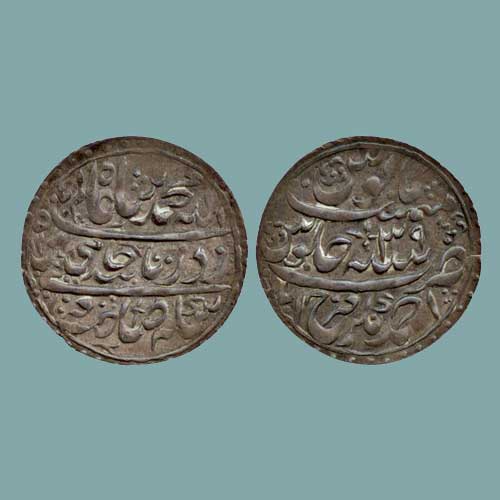
One example of this demand is the above-shown a Silver nazarana rupee coin which belongs to the Bengal Presidency. The obverse of this coin depicts full title of king, within the dotted border. The reverse of this coin inscribes the mint Ahmednagar-Farukhabad, date AH1218 / RY 39.
The EIC got the possession of Bengal, Orissa and Bihar in 1765 by Emperor Shah Alam. The shift of the territories and the political power made EIC responsible directly under the Emperor. Many mints were established by EIC.
The supremacy of EIC on Bengal became stronger after the battle of Plassey. Later on, the Battle of Buxar hammered the nail of East Indian Company’s administration in the northern belt of India. These Battles triggered the start of colonialism and slavery for coming two centuries in India. These all events took place due to the greed of few traders who wanted a huge profit with less investment.
To know more about Bengal presidency click here .
Latest News
-
Bow and Arrow on an Ancient Chera Copper Coin of the Sangam Age
2026-10-09 FriIn our ongoing series exploring the coinage of the Sangam Age, this uninscribed copper coin attri...
-
Symbolic Motifs on an Ancient Chola Copper Coin of the Sangam Age
2026-10-09 FriThe Chola dynasty was one of the three great ruling houses of ancient Tamilakam, alongside the Ch...
-
Iconography of Chera Dynasty on a Square Copper Coin
2026-10-08 ThuThe Cheras were one of the three great crowned dynasties of ancient Tamilakam, alongside the Chol...
-
Decoding the Symbols of a Sangam Age Pandyan Copper Coin
2026-10-08 ThuThe Sangam age is generally placed broadly between c. 300 BCE and 300 CE, although the chronology...
-
Royal Emblems on a Gold Kahavanu of Rajendra Chola
2026-10-07 WedRajendra Chola I (1012–1044 AD) was one of the most powerful rulers of the Chola dynasty and th...