
2026-08-11 Tue
It is interesting to note that Indore was once the capital of one of the most prominent Maratha states in Central India.
The Holkar dynasty rose to prominence in the early 18th century under Malhar Rao Holkar (c. 1693–1766), a skilled cavalry commander serving Peshwa Baji Rao I. Belonging to a Maratha Dhangar (shepherd) clan, Malhar Rao earned recognition for his military service in the Malwa region, receiving substantial territories that included the area around Indore.
The golden age of the state is often associated with the enlightened rule of Ahilyabai Holkar (1767–1795), who shifted the capital to Maheshwar on the Narmada and became renowned for just administration, temple construction, and public welfare.
Tukoji Rao II Holkar (born 3 May 1835, died 17 June 1886) was the eleventh Holkar Maharaja of Indore. He was coronated in 1844 at the age of nine. A period of regency under British supervision followed until he was granted full ruling powers in 1852.
His reign period is remembered for consolidation, administrative reform, and economic progress. He improved land revenue administration, encouraged agriculture and irrigation, and raised the annual state income from roughly 22 lakh to 85 lakh rupees. Some of his most lasting contributions were the promotion of railways, infrastructure projects, hospitals, and palace constructions.
Holkars had long issued silver and copper coins from mints such as Indore (Malharganj) and earlier Maheshwar. Under Tukoji Rao II the state continued regular issues, but around Saka Era 1780 (AD 1858)—in the immediate aftermath of the 1857–59 upheavals—an enigmatic experimental series known as the “Mudra” coinage appeared. These were not intended for ordinary circulation. They were largely patterns, trial strikes, and specially prepared presentation (Nazarana) pieces, possibly an attempt at a more innovative or partly machine-struck currency that never progressed beyond limited production. The rare silver Nazarana Mudras of this series rank among the most interesting numismatic products of the Holkar court.
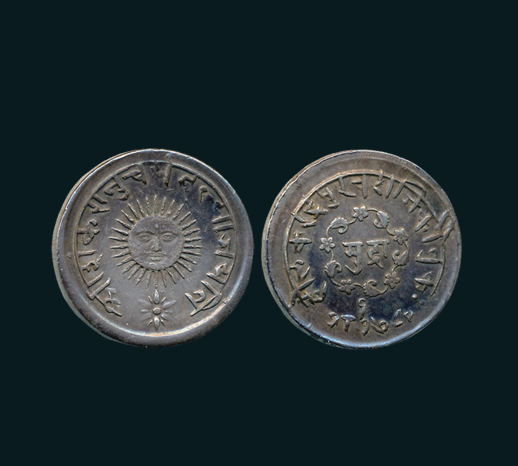
Today, we will be seeing silver (Nazarana) Mudra Rupee struck in the name of Tukoji Rao II. It weighs 11.18 grams and is dated Saka Era (SE) 1780, corresponding to AD 1858. The obverse depicts a radiant sun-face (emblem of the Holkars) occupies the center. Around it runs the Sanskrit legend “Shri Shankaranucharya ahlya Jayati.” The reverse features the legend “Mudra” appears in the centre, enclosed within an ornate floral or scroll design. Surrounding it is the legend “Holakarendra Puravaraji Kautukah Saka 1780.”
As a Nazarana issue, the coin was struck with greater care and intended for ceremonial presentation, gifts, or formal offerings rather than everyday commerce. Its relatively high weight for a presentation piece, the use of pure Sanskrit legends, the solar emblem, and the experimental “Mudra” designation all underline its special character.
-
Rare Nazarana Rupee of the Holkar State, depicting King Jaswant Rao as a bee at the feet of Lord Vishnu
2026-08-11 Tue -
Elegant Gold Mohur of Maharaja Pratap Singh, Baroda
2026-08-10 Mon -
Lakshman Singh’s Gold Nazarana Mohur of Dungarpur
2026-08-10 Mon -
Nanaia Type Copper Coin of Emperor Kanishka I, Kushan
2026-08-07 Fri -
Lanky Bull/ Nandi Type Copper Unit of Kaushambi City State
2026-08-07 Fri