
2026-08-11 Tue
In the previous article we have seen a rare issue of Tukoji Rao II. Let’s turn to an earlier and equally remarkable coin struck by one of the most dynamic rulers of the dynasty.
Maharaja Yashwant Rao Holkar, also known as Jaswant Rao or Jaswantrao (1776–1811), was the son of Tukoji Rao Holkar I and one of the most brilliant military leaders produced by the Holkar house. Rising to power amid intense family rivalries after the deaths of Ahilyabai and Tukoji Rao I, he established firm control by 1799 and ruled until his death in 1811.
Yashwantrao repeatedly defeated larger armies. He overcame rival claimants and Scindia forces, routed British columns under Colonel William Monson, and advanced toward Delhi in a bold attempt to free the Mughal emperor Shah Alam II from British influence. Historians regard him as one of the last great independent Maratha generals—an organiser of armies, a daring strategist, and a ruler who briefly restored Holkar prestige at a time of growing British dominance. He died in October 1811.
Yashwantrao’s coinage is especially distinctive. While most Indian mints of the period continued to issue coins with Persian legends in the traditional Mughal style, he introduced a rare series of silver Nazarana rupees bearing elegant Sanskrit inscriptions in the Devanagari script. These pieces combine religious devotion, political diplomacy and personal assertion of authority, making them unique in the Holkar series.
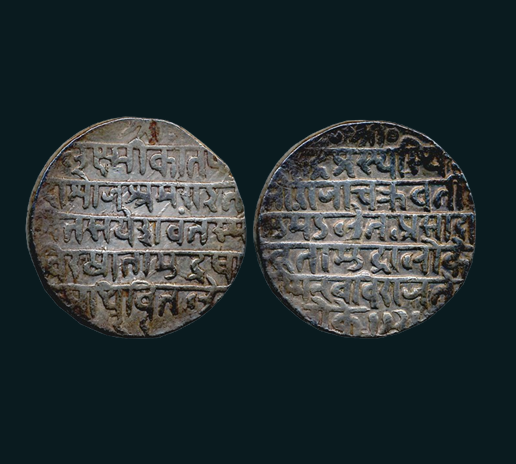
Here, silver Nazarana Rupee of the “Sanskrit legend” type issued by Jaswant Rao Holkar. It weighs 11.27 grams and is dated Saka Era (SE) 1728, corresponding to AD 1806.
The obverse legend reads “Sri Laxmikanta Padambhokja, Bhramarayita Chetasa Yeshwantasa Vikhyata Mudrasa Pritivitale” which means “This renowned coin (mudra) of Yashwant, whose mind is like a bee hovering at the lotus feet of Sri Lakshmikanta (Lord Vishnu), is famous throughout the earth.”
The poetic image of the ruler’s mind as a bee devotedly circling the lotus feet of Vishnu expresses deep Vaishnava piety while proudly declaring the fame of Yashwant’s coinage across the world.
The reverse legend is “Sri Indraprastha Sthito Raja Chakravarti Bhumandale, Tatprasadata Krita Mudra Lokesminvaivirajite” translated as “This coin, struck by the grace of the Chakravarti (Universal Emperor) who resides in Indraprastha (Delhi) and rules the circle of the earth, shines forth in this world.”
Issued at a politically sensitive moment around the accession of the Mughal emperor Muhammad Akbar II and during Yashwantrao’s efforts to assert Holkar sovereignty, this silver Nazarana Rupee stands as a remarkable document of its time. It unites Sanskrit literary elegance, religious sentiment and subtle political messaging, offering a rare glimpse into the mind and ambition of one of the last great independent Holkar rulers.
Read our previous article on Silver Nazarana Mudra of Tukoji Rao II, Holkar State.
-
Silver Nazarana Mudra of Tukoji Rao II, Holkar State
2026-08-11 Tue -
Elegant Gold Mohur of Maharaja Pratap Singh, Baroda
2026-08-10 Mon -
Lakshman Singh’s Gold Nazarana Mohur of Dungarpur
2026-08-10 Mon -
Nanaia Type Copper Coin of Emperor Kanishka I, Kushan
2026-08-07 Fri -
Lanky Bull/ Nandi Type Copper Unit of Kaushambi City State
2026-08-07 Fri