
Tigers in The Heart of India
2017-07-05 Wed
“If you feel like shooting them, shoot them on your camera”.This massive landmass of the Indian peninsula is ornamented with natural beauty. This subcontinent gives a fine example of diversity in its flora and fauna adorned with the magnificent Himalayas, Thar Desert and Chirapunji (wettest place in the world) in one segment. India is also a place for many animals that brighten this land’s beauty. Unfortunately, today many of these animals are endangered and one of them is the mightiest in the cat family- Bengal Tiger.
The Bengal tiger has been India’s national symbol since the 25th century BCE when it was depicted on a Pashupatinath seal of Indus valley civilisation. This tiger later became the symbol of the Chola Empire from 300 CE to 1279 CE. Today it is classified as the ‘national animal of India’. Tigers population is concentrated in the heart of India- ‘Madhya Pradesh' which houses 1/6th of the entire tiger population of the World.
The population of Tigers was 40,000 in the start of the 20th century but in 1973, it was just 1,800. To protect this alluring beauty, the Government of India has launched a Tiger Project- ‘Palamau’, a tiger reserve in Jharkhand. Many other tiger conservation projects began and under it, many tiger reserves were established. Madhya Pradesh holds 19% of the Tiger population in India. Tigers are being preserved in national parks and sanctuaries like Kanha, Bandhavgarh, Pench, Panna and Satpura National Park under this project.
Tigers are an important part of the ecosystem; if one block is disturbed, the whole system will collapse. So help save tigers, visit their home as a guest and not as an intruder.
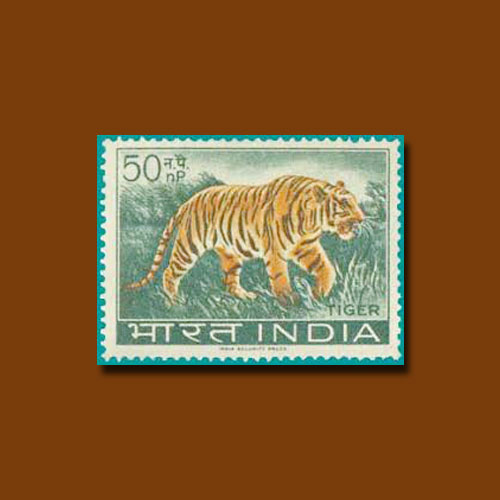
To support the cause of tiger conservation, India post issued a commemorative stamp in 1963.
An Interesting fact;
The Pench National Park was also the setting for Rudyard Kipling's famous novel The Jungle Book. Due to this, the park has also been nicknamed "Mowgli".
Latest News
-
Bow and Arrow on an Ancient Chera Copper Coin of the Sangam Age
2026-10-09 FriIn our ongoing series exploring the coinage of the Sangam Age, this uninscribed copper coin attri...
-
Symbolic Motifs on an Ancient Chola Copper Coin of the Sangam Age
2026-10-09 FriThe Chola dynasty was one of the three great ruling houses of ancient Tamilakam, alongside the Ch...
-
Iconography of Chera Dynasty on a Square Copper Coin
2026-10-08 ThuThe Cheras were one of the three great crowned dynasties of ancient Tamilakam, alongside the Chol...
-
Decoding the Symbols of a Sangam Age Pandyan Copper Coin
2026-10-08 ThuThe Sangam age is generally placed broadly between c. 300 BCE and 300 CE, although the chronology...
-
Royal Emblems on a Gold Kahavanu of Rajendra Chola
2026-10-07 WedRajendra Chola I (1012–1044 AD) was one of the most powerful rulers of the Chola dynasty and th...