
2026-11-27 Fri
The Kalachuris of Mahishmati, also known as the Early Kalachuris, were an influential dynasty that ruled parts of central and western India during the 6th and early 7th centuries CE. Their kingdom was centred around Mahishmati, an important ancient city traditionally identified with Maheshwar on the banks of the River Narmada in present-day Madhya Pradesh. Their territories extended across parts of present-day Madhya Pradesh, Maharashtra and Gujarat.
The precise origin of the Kalachuris remains uncertain. Some historical traditions associate them with the Haihayas, an ancient Kshatriya lineage mentioned in Hindu epics and Puranic literature. The Haihayas traced their ancestry to the legendary King Kartavirya Arjuna, who was traditionally associated with Mahishmati. However, this genealogical connection is not conclusively established by contemporary evidence. The dynasty is also referred to by different names, including Kalachuri, Kalatsuri and Katatchuri, in historical records.
The Kalachuris rose to prominence following the decline of the Traikutakas and the weakening of other regional powers, including the Vakatakas and the Guptas. Mahishmati became their principal political centre, while their influence extended into important regions of western and central India.
Krishnaraja (c. 550–575 CE) was the earliest known ruler of the Kalachuris of Mahishmati and is generally regarded as the founder or consolidator of their early kingdom. He expanded the political influence of the dynasty across parts of western and central India, taking advantage of the changing political circumstances following the decline of earlier ruling powers.
Although no independent inscription of Krishnaraja has been conclusively identified, his reign is particularly well documented through his coinage. His silver coins have been discovered across a remarkably wide geographical area, extending from Rajasthan and Malwa in the north to Maharashtra in the south and from the western coast to Vidarbha and parts of Madhya Pradesh in the east. However, their widespread circulation does not necessarily indicate the extent of his territorial control.
Krishnaraja's coinage reflects the influence of earlier Western Kshatrapa, Traikutaka and Gupta monetary traditions. His coins also reveal his religious affiliation, as he was a devoted worshipper of Lord Shiva. The title Paramamaheshvara used in his coin legends indicates his devotion to Maheshvara (Shiva). He was succeeded by Shankaragana, followed by Buddharaja, under whose reign the dynasty eventually faced the growing power of the Chalukyas of Badami.
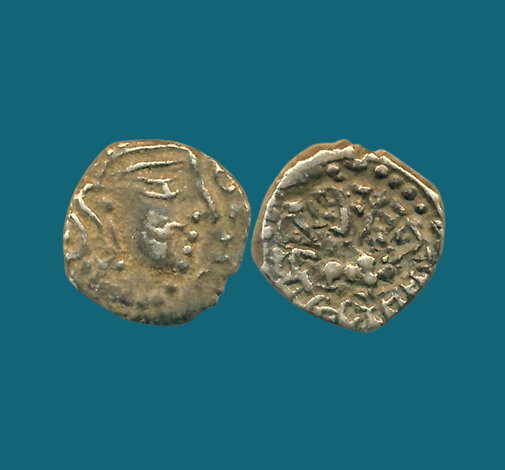
The silver drachm described here is an interesting example of the coinage issued by King Krishnaraja. Weighing 1.75 grams, it reflects the monetary traditions of the early Kalachuris and their adaptation of established coin designs.
The obverse features the bust of the king facing right, following the portrait style seen on earlier Western Kshatrapa and Gupta-inspired coinage. The reverse depicts Nandi, the sacred bull and vehicle of Lord Shiva, resting and facing right at the centre. Surrounding the bull is a Brahmi inscription reading "Paramamahesvara Matapitrpadanudhyata Srikrisnaraja." The legend translates as "The illustrious Krishnaraja, a supreme devotee of Maheshvara, who meditates upon the feet of his parents."
The inscription is particularly significant as it highlights two aspects of the king's identity: his devotion to Lord Shiva and his reverence for his parents. The depiction of Nandi further reinforces his Shaivite religious affiliation.
This silver drachm is an important numismatic record of the Kalachuris of Mahishmati. Through its portrait, religious symbolism and Brahmi inscription, it provides valuable insights into the political authority, religious beliefs and monetary traditions of one of early medieval India's significant regional dynasties.
-
Goddess Lakshmi on Rajanyas Janapada Copper Coin
2026-11-27 FriThe Rajanyas were an ancient Janapada that flourished in northern India during the post-Mauryan p...
-
Swastika on Copper Drachm of Koziya of the Paratarajas of Baluchistan
2026-11-26 ThuThe Paratarajas, also known as the Parata kings, were an ancient ruling dynasty that governed the...
-
Silver Masha of Jagapala, Feudatory of the Kalachuris of Ratanpur
2026-11-26 ThuThe Kalachuris of Ratanpur, also known as the Kalachuris of Ratnapura, were an influential mediev...
-
Gold 4½ Masha of Gangeya Deva of the Kalachuris of Tripuri
2026-11-25 WedHaving explored an interesting example of the pre-Satavahana local coinage of Tripuri, we now tur...
-
Lead Coin of Pre-Satavahana Local Coinage of Tripuri
2026-11-25 WedThe ancient region of Tripuri, identified with modern Tewar near Jabalpur in Madhya Pradesh, was ...