
2026-11-25 Wed
The ancient region of Tripuri, identified with modern Tewar near Jabalpur in Madhya Pradesh, was an important political and commercial centre in central India. Situated in the Narmada Valley, Tripuri developed a distinctive tradition of local coinage during the post-Mauryan period, before the expansion of the Satavahanas into the region. Its early monetary issues provide valuable insights into the political, economic and cultural developments of this period.
The pre-Satavahana coinage of Tripuri is particularly interesting for its distinctive iconography and use of lead as a principal metal. Several uninscribed and inscribed issues are associated with local ruling families, including the Datta rulers, whose coins are generally attributed to the second and first centuries BCE. A characteristic feature of Tripuri's early coinage is the depiction of a standing human figure, which continued to appear on the issues of subsequent ruling authorities. This recurring motif is considered an important identifying feature of the region's numismatic tradition.
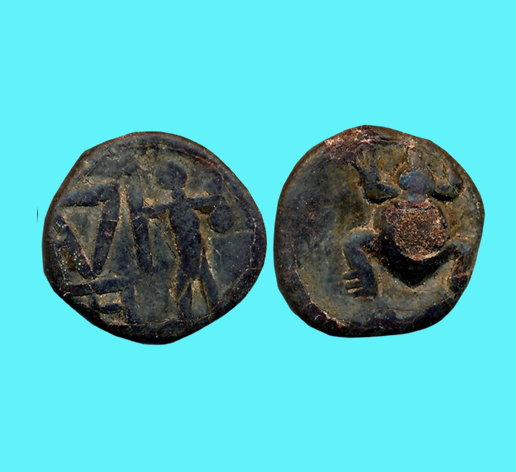
The present coin, weighing 4.97 g, is an interesting uninscribed lead issue belonging to this early series. Its obverse depicts a triangle-headed standard, possibly representing an Indradhvaja, enclosed within a railing on the left. To its right is a standing human figure holding a stick and a water pot. The combination of the anthropomorphic figure and religious or ceremonial symbolism reflects the distinctive visual vocabulary employed by the early moneyers of Tripuri.
The reverse features a large frog, depicted prominently across the surface. Animal representations were an important component of early Indian coin iconography, often serving as distinctive motifs that helped differentiate regional coin types. The prominent placement of the frog makes this specimen particularly unusual and adds to its numismatic significance.
Unlike later inscribed coinage, the absence of a royal legend on this specimen makes its precise issuing authority difficult to establish. Nevertheless, its characteristic motifs and fabric connect it with the indigenous monetary tradition of ancient Tripuri. Such coins also illustrate the regional character of early Indian currency, which often relied on distinctive symbols rather than written royal identities.
This specimen, preserved in an extremely fine condition for its type, is particularly noteworthy for its unusual frog motif and distinctive combination of symbols. An exceptionally rare example of the early uninscribed coinage of Tripuri, it offers a fascinating glimpse into the region's monetary and artistic traditions before the Satavahana period.
-
Gold 4½ Masha of Gangeya Deva of the Kalachuris of Tripuri
2026-11-25 WedHaving explored an interesting example of the pre-Satavahana local coinage of Tripuri, we now tur...
-
Rare Gold Punch-Marked Gadyana of Jogama, Feudatory of the Chalukyas of Kalyana
2026-11-24 TueThe Chalukyas of Kalyana, also known as the Western Chalukyas, were a prominent dynasty that rule...
-
Silver Half Karshapana Attributed to the Shurasena Mahajanapada
2026-11-24 TueThe Shurasena Janapada was one of the sixteen Mahajanapadas (great territorial states) of ancient...
-
Matsya Avatar of Lord Vishnu on a Copper Coin of the Madurai Nayakas
2026-11-23 MonLord Vishnu is one of the principal deities of Hinduism and is revered as the preserver and prote...
-
Silver Punch-Marked Coin of the Matsya Janapada
2026-11-23 MonPunch-marked coins represent some of the earliest forms of coinage in ancient India, emerging aro...