
2026-11-26 Thu
The Paratarajas, also known as the Parata kings, were an ancient ruling dynasty that governed the historical region of Paradan, comprising parts of present-day Balochistan and adjoining north-western Sindh in Pakistan. They flourished approximately between the 1st and 3rd centuries CE and are believed to have had connections with the Parthians of Iranian tradition. Their coinage provides valuable evidence of the political, cultural and commercial interactions between the Iranian and Indian worlds.
One of the notable rulers of this dynasty was Koziya, son of Kozana, who ruled approximately between 230 and 270 CE. His extensive coinage includes copper and other denominations, bearing distinctive royal portraits and inscriptions in Kharosthi script. His coins are particularly interesting for illustrating the evolution of Parataraja coinage and its changing artistic styles.
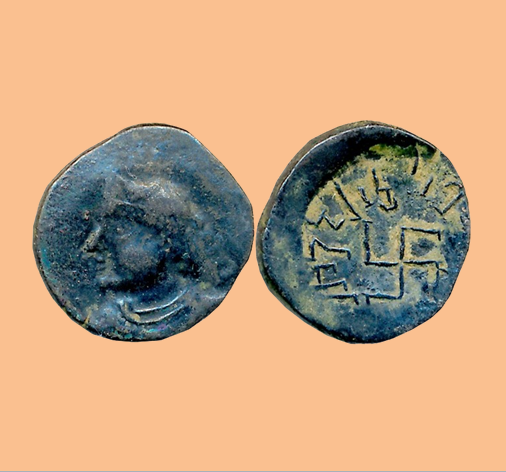
This copper drachm, weighing 1.98 grams, was issued during Koziya's reign. The obverse depicts a crowned bust of the king facing left, with a prominent moustache. The royal portrait reflects the influence of contemporary Indo-Parthian and western regional coinage traditions. The reverse features a Swastika at the centre, surrounded by a Kharosthi inscription, partially visible on this specimen, reading ‘Koziyasa Kozanaputrasa Parataraja’, identifying Koziya as the son of Kozana and a ruler of the Paratarajas.
The Swastika is among the oldest auspicious symbols known to humanity. Derived from the Sanskrit word svastika, meaning well-being or good fortune, it has been used for thousands of years across different cultures. In India, it holds profound religious significance in Hinduism, Buddhism and Jainism, symbolising prosperity, auspiciousness, eternity and the cyclical nature of existence.
Its appearance on Parataraja coinage demonstrates the importance of this symbol in the region's cultural and religious vocabulary. The continued use of the Swastika on coins also highlights its significance as a recognisable emblem of auspiciousness and authority.
This remarkable coin offers an insight into Koziya's reign, the monetary traditions of the Paratarajas and the enduring cultural significance of ancient Indian symbolism.
-
Silver Masha of Jagapala, Feudatory of the Kalachuris of Ratanpur
2026-11-26 ThuThe Kalachuris of Ratanpur, also known as the Kalachuris of Ratnapura, were an influential mediev...
-
Gold 4½ Masha of Gangeya Deva of the Kalachuris of Tripuri
2026-11-25 WedHaving explored an interesting example of the pre-Satavahana local coinage of Tripuri, we now tur...
-
Lead Coin of Pre-Satavahana Local Coinage of Tripuri
2026-11-25 WedThe ancient region of Tripuri, identified with modern Tewar near Jabalpur in Madhya Pradesh, was ...
-
Rare Gold Punch-Marked Gadyana of Jogama, Feudatory of the Chalukyas of Kalyana
2026-11-24 TueThe Chalukyas of Kalyana, also known as the Western Chalukyas, were a prominent dynasty that rule...
-
Silver Half Karshapana Attributed to the Shurasena Mahajanapada
2026-11-24 TueThe Shurasena Janapada was one of the sixteen Mahajanapadas (great territorial states) of ancient...