
2026-11-25 Wed
Having explored an interesting example of the pre-Satavahana local coinage of Tripuri, we now turn our attention to a much later phase in the region's numismatic history, represented by the coinage of the Kalachuris of Tripuri. Also known as the Haihayas, the Kalachuris were an influential medieval Indian dynasty that ruled over the region of Dahala, encompassing parts of present-day Madhya Pradesh and adjoining territories. Their capital was Tripuri, identified with modern Tewar, near Jabalpur. The dynasty emerged as a significant political power in central India between the 9th and 12th centuries CE. Among its prominent rulers were Kokkalla I, who laid the foundations of its political influence, Gangeya Deva, under whom the kingdom reached considerable prominence, and his son Lakshmikarna, who further expanded its power.
Gangeya Deva (c. 1015–1041 CE) was one of the most powerful monarchs of the Kalachuris of Tripuri. During his reign, he considerably expanded the kingdom's influence beyond its traditional territories through military campaigns and political alliances. His dominions extended across significant parts of central India, and he established himself as an important power in the contemporary political landscape. He assumed the prestigious title Vikramaditya and is remembered for strengthening the authority of the Kalachuri dynasty. Gangeya Deva was also an important issuer of gold, silver and copper coinage, reflecting the monetary and commercial activities of his kingdom.
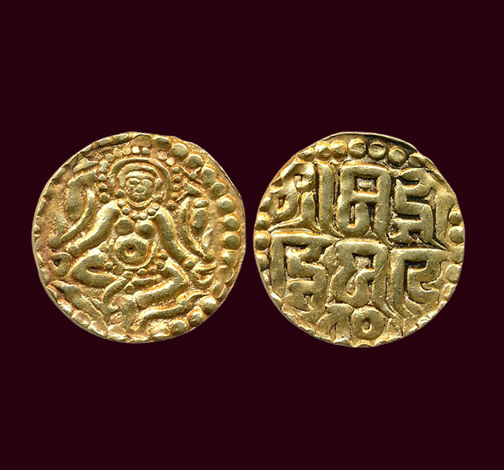
The present coin is a gold 4½ Masha denomination weighing 4.07 g, issued during his reign. Masha is a traditional Indian unit of weight, historically used for weighing gold, silver and other precious metals. The term is derived from the Sanskrit word Maṣa (माष), originally meaning a black gram (urad bean), which was also used as a standard weight.
• 1 Masha = 8 Ratti
• 1 Masha ≈ 0.97 grams
• 1 Tola = 12 Masha ≈ 11.66 grams
Its obverse features a stylized representation of Goddess Lakshmi seated facing forward. The goddess, associated with wealth, prosperity and good fortune, occupies the central field. Nine prominent dots are arranged along her girdle, forming a distinctive decorative feature of this particular variety.
The reverse bears the ruler's name in Devanagari script, arranged in three horizontal lines, reading “Srimad Ga-ngeya De-vah” (श्रीमद् गांगेय देवः), meaning “The illustrious Gangeya Deva.” The inscription clearly identifies the issuing monarch and reflects the growing use of Nagari script in the coinage of medieval north and central India. The combination of Goddess Lakshmi on the obverse and the ruler's name on the reverse conveys both religious symbolism and royal authority.
-
Lead Coin of Pre-Satavahana Local Coinage of Tripuri
2026-11-25 WedThe ancient region of Tripuri, identified with modern Tewar near Jabalpur in Madhya Pradesh, was ...
-
Rare Gold Punch-Marked Gadyana of Jogama, Feudatory of the Chalukyas of Kalyana
2026-11-24 TueThe Chalukyas of Kalyana, also known as the Western Chalukyas, were a prominent dynasty that rule...
-
Silver Half Karshapana Attributed to the Shurasena Mahajanapada
2026-11-24 TueThe Shurasena Janapada was one of the sixteen Mahajanapadas (great territorial states) of ancient...
-
Matsya Avatar of Lord Vishnu on a Copper Coin of the Madurai Nayakas
2026-11-23 MonLord Vishnu is one of the principal deities of Hinduism and is revered as the preserver and prote...
-
Silver Punch-Marked Coin of the Matsya Janapada
2026-11-23 MonPunch-marked coins represent some of the earliest forms of coinage in ancient India, emerging aro...