
2026-11-27 Fri
The Rajanyas were an ancient Janapada that flourished in northern India during the post-Mauryan period, approximately between the 2nd and 1st centuries BCE. They are known primarily through their coinage, which provides valuable evidence of their political identity and cultural traditions. The term Rajanya is associated with the Kshatriya or warrior class, suggesting that the community may have had a strong martial character.
The Rajanyas find mention in ancient Indian literary and grammatical sources, including the works of Panini and Patanjali. They are believed to have inhabited parts of northwestern India, particularly the Punjab region, although their exact geographical location remains debated. Based on archaeological discoveries and coin findspots, scholars have variously suggested eastern Punjab and parts of eastern Rajasthan as their territory. Coins bearing their name have been reported from the Hoshiarpur region of Punjab.
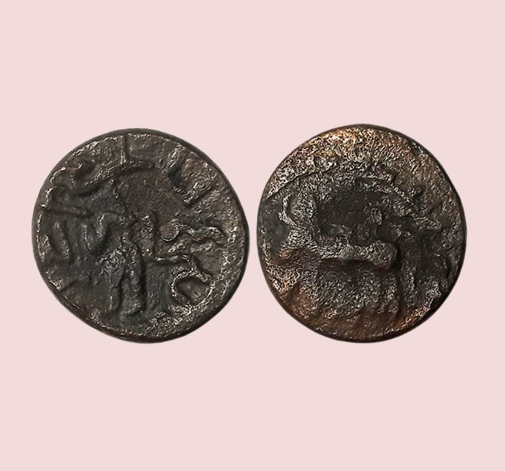
The Rajanyas were among several regional communities that issued their own coinage during the centuries following the decline of the Mauryan Empire. Their coins are particularly significant because they bear the name of the janapada rather than that of an individual ruler, indicating a collective political identity. Their copper issues generally feature a standing female deity on the obverse and a bull within a rayed circle on the reverse. The female figure is commonly identified as Goddess Lakshmi, although alternative interpretations have also been proposed.
The coin described here is an interesting example of the copper coinage issued by the Rajanyas. Its obverse features a standing female figure, generally identified as Goddess Lakshmi, accompanied by the complete Brahmi legend RAJANA JANAPADASA (Rajanya Janapadasa), meaning “of the Rajanya people.” The inscription establishes the issuing community's identity and makes this coin an important example of ancient Indian tribal coinage.
The reverse depicts a bull facing left within a circular border of radiating lines. The bull was a recurring motif in ancient Indian coinage and may have carried religious and cultural significance. The combination of the female deity and the bull reflects the artistic and symbolic traditions prevalent in northern India during this period.
Weighing 3.44 grams, this copper coin represents the monetary and political history of the Rajanyas. Its distinctive iconography and inscription make it an important numismatic record of a regional community whose history is otherwise relatively obscure.
The coin offers valuable insight into the political identity, religious imagery and monetary practices of the Rajanyas, highlighting the diversity of indigenous coin-issuing communities in post-Mauryan India.
-
Silver Drachm of King Krishnaraja, Kalachuris of Mahishmati
2026-11-27 FriThe Kalachuris of Mahishmati, also known as the Early Kalachuris, were an influential dynasty tha...
-
Swastika on Copper Drachm of Koziya of the Paratarajas of Baluchistan
2026-11-26 ThuThe Paratarajas, also known as the Parata kings, were an ancient ruling dynasty that governed the...
-
Silver Masha of Jagapala, Feudatory of the Kalachuris of Ratanpur
2026-11-26 ThuThe Kalachuris of Ratanpur, also known as the Kalachuris of Ratnapura, were an influential mediev...
-
Gold 4½ Masha of Gangeya Deva of the Kalachuris of Tripuri
2026-11-25 WedHaving explored an interesting example of the pre-Satavahana local coinage of Tripuri, we now tur...
-
Lead Coin of Pre-Satavahana Local Coinage of Tripuri
2026-11-25 WedThe ancient region of Tripuri, identified with modern Tewar near Jabalpur in Madhya Pradesh, was ...