
2026-11-23 Mon
Punch-marked coins represent some of the earliest forms of coinage in ancient India, emerging around the 6th century BCE. They played an important role in the development of monetary systems, trade and economic activity across the Indian subcontinent. Unlike later coins bearing portraits, inscriptions or elaborate designs, punch-marked coins were produced by stamping individual symbols onto prepared pieces of metal, generally silver. The coins were often irregular in shape and varied in weight, reflecting the different monetary standards followed by contemporary kingdoms and regional authorities.
The symbols punched onto these coins included geometric patterns, solar motifs, animals, plants and other distinctive designs. Their arrangements and manufacturing techniques provide valuable insights into the political and economic organisation of early Indian states. Among the earliest issues are the regional coinages associated with the sixteen Mahajanapadas and other smaller Janapadas, which flourished during the period of early urbanisation.
The Matsya Janapada was one of the sixteen Mahajanapadas mentioned in ancient Indian literature. Its traditional geographical centre lay in present-day Rajasthan, with Viratanagara (modern Bairat) regarded as its capital. It was surrounded by important neighbouring territories, including the Kuru and Surasena regions. However, numismatic discoveries from the Agra region and the Upper Ganga-Yamuna river systems have brought attention to an interesting group of archaic silver coins attributed to the Matsya Janapada. These issues, associated with the Chambal Valley and western Uttar Pradesh, represent a distinctive regional coinage tradition. Their study has helped expand our understanding of the geographical distribution and monetary practices of early Janapada-period communities.
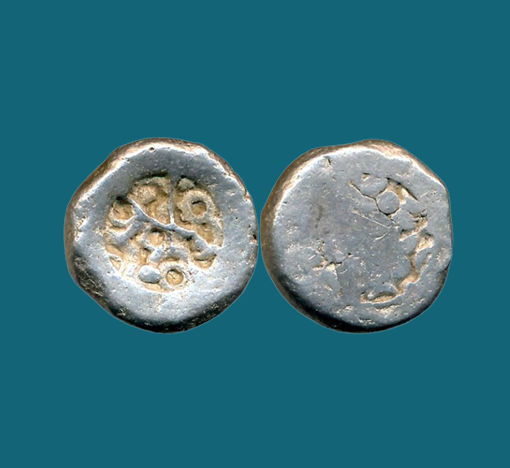
The featured coin is an interesting example of this archaic coinage tradition, attributed to the Matsya Janapada of the Chambal Valley–Agra region. Struck in silver, it weighs 3.13 grams and belongs to the uniface, single-punch variety. Its most striking feature is the deep and bold punch impressed prominently at the centre of the flan. Unlike multi-symbol punch-marked coins, which carry several individual impressions, this specimen displays a single dominant punch, giving it a distinctive and relatively simple appearance.
The coin is particularly noteworthy for its unusual manufacturing and punching technique, as well as its regional attribution. It is reported as an unpublished variety, not listed in Rajgor's classification of ancient Indian punch-marked coins. Such rare specimens are significant for numismatic research, as they offer opportunities to identify previously undocumented punch types and refine our understanding of early regional coinage.
This silver issue is therefore an important addition to the study of archaic Indian monetary history, highlighting the diversity of coin-making traditions that existed during the age of the Janapadas.
-
Matsya Avatar of Lord Vishnu on a Copper Coin of the Madurai Nayakas
2026-11-23 MonLord Vishnu is one of the principal deities of Hinduism and is revered as the preserver and prote...
-
Lion and Elephant Type Copper Drachma of Taxila
2026-11-21 SatIn Continuation, let’s explore another coin of ancient Taxila, we turn our attention to another...
-
Shivapindi depicted on a Copper Coin of Taxila
2026-11-21 SatTaxila, known in ancient Indian literature as Takshashila, was one of the most important urban, c...
-
Gold Varaha-Gadyana, Lion Type Coin of Govinda IV of the Rashtrakutas
2026-11-20 FriThe Rashtrakutas were among the most prominent imperial dynasties of early medieval India, exerci...
-
Elephant and Garuda on Rashtrakutas Silver Coin
2026-11-20 FriThe Rashtrakutas were one of the most powerful and influential ruling dynasties of early medieval...