
2026-11-23 Mon
Lord Vishnu is one of the principal deities of Hinduism and is revered as the preserver and protector of the universe in the Hindu trinity, alongside Brahma, the creator, and Shiva, the destroyer and transformer. According to Hindu tradition, Vishnu incarnates on Earth whenever cosmic order (Dharma) is threatened by evil and unrighteousness. These divine manifestations are known as avatars.
Vishnu is traditionally associated with ten principal incarnations, collectively known as the Dashavatara. They are Matsya (fish), Kurma (tortoise), Varaha (boar), Narasimha (half-man, half-lion), Vamana (dwarf), Parashurama, Rama, Krishna, Buddha and Kalki. While the first nine are associated with different mythological narratives and traditions, Kalki is believed to appear in the future, at the end of the present age of Kali Yuga, to restore righteousness.
Among these incarnations, Matsya Avatar, the fish incarnation, is particularly significant as it represents Vishnu's role as the protector of life and the preserver of sacred knowledge. According to Hindu mythology, during a catastrophic deluge, Vishnu appeared as a fish and rescued King Manu, the progenitor of humankind, by guiding his boat to safety. The boat carried the seven sages (Saptarishis), seeds and other essential elements necessary for the regeneration of life. The Matsya narrative is described in several Hindu scriptures, including the Matsya Purana and the Bhagavata Purana.
The Matsya Avatar is generally depicted either as a complete fish or as a divine figure with a human upper body and a fish-like lower body. In traditional iconography, Vishnu in this form is often shown holding the conch (Shankha) and discus (Chakra), his characteristic divine attributes.
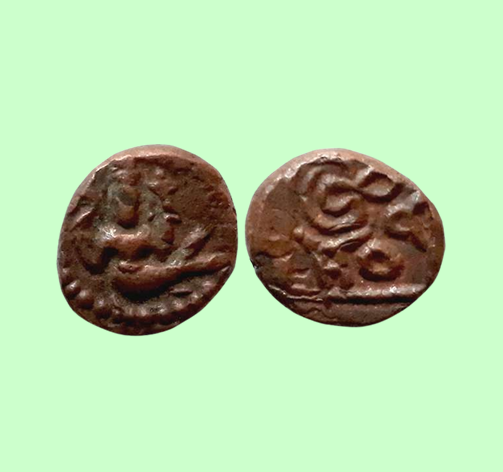
The featured coin belongs to the Madurai Nayakas, who ruled large parts of southern Tamil Nadu from the 16th to the 18th centuries CE. Originally appointed as governors under the Vijayanagara Empire, the Nayakas gradually established independent kingdoms as Vijayanagara's authority weakened. They made significant contributions to temple architecture, religious patronage, literature and regional art. Their coinage predominantly consisted of copper issues, featuring Hindu deities, religious symbols and legends in regional scripts.
This interesting copper coin weighs 2.36 grams and features a beautiful representation of Vishnu's Matsya Avatar.
Obverse: Lord Vishnu is depicted in his Matsya Avatar, flanked by the conch (Shankha) and discus (Chakra), enclosed within a dotted border.
Reverse: The Telugu legend “Sri Ranga” appears within a square border.
The coin is particularly fascinating for its religious imagery, combining the Matsya incarnation of Vishnu with a Telugu inscription. It reflects the important role of Vaishnavism in the religious and cultural life of the Nayaka period and demonstrates how regional coinage served as a medium for expressing religious devotion and royal identity.
-
Silver Punch-Marked Coin of the Matsya Janapada
2026-11-23 MonPunch-marked coins represent some of the earliest forms of coinage in ancient India, emerging aro...
-
Lion and Elephant Type Copper Drachma of Taxila
2026-11-21 SatIn Continuation, let’s explore another coin of ancient Taxila, we turn our attention to another...
-
Shivapindi depicted on a Copper Coin of Taxila
2026-11-21 SatTaxila, known in ancient Indian literature as Takshashila, was one of the most important urban, c...
-
Gold Varaha-Gadyana, Lion Type Coin of Govinda IV of the Rashtrakutas
2026-11-20 FriThe Rashtrakutas were among the most prominent imperial dynasties of early medieval India, exerci...
-
Elephant and Garuda on Rashtrakutas Silver Coin
2026-11-20 FriThe Rashtrakutas were one of the most powerful and influential ruling dynasties of early medieval...