
2026-11-24 Tue
The Shurasena Janapada was one of the sixteen Mahajanapadas (great territorial states) of ancient India, mentioned in Buddhist and Jain literary traditions. It was situated in the Braj region of present-day Uttar Pradesh, with Mathura serving as its principal political and cultural centre. Located along important trade routes, the region developed into a significant centre of commerce, religious activity and cultural exchange. Mathura also acquired considerable importance in the history of Hinduism, Buddhism and Jainism. Although the political history of Shurasena during the early historic period remains relatively obscure, its association with the Mahajanapada system highlights its importance in the political landscape of northern India.
The term Karshapana (कार्षापण) refers to an ancient Indian monetary denomination used in early commercial transactions. The word is generally understood as a compound derived from Karsha, an ancient unit of weight, and Pana, meaning money or a coin. Thus, Karshapana originally denoted a coin associated with a prescribed weight standard. The term also appears in ancient Indian literary and grammatical sources, including Buddhist Jataka tales and Panini's Ashtadhyayi. Karshapanas were predominantly made of silver and were widely used in trade and commerce. Their fractional denominations facilitated smaller transactions and reflected the development of an organised monetary economy.
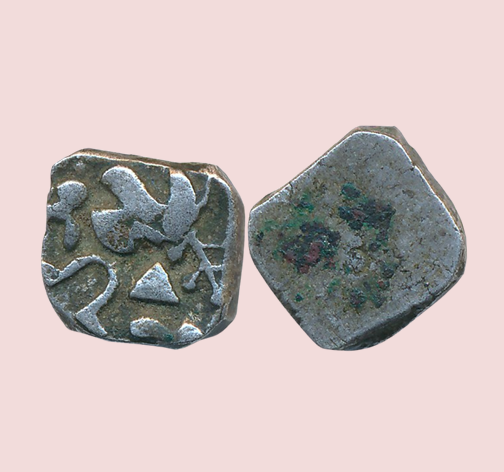
The featured coin is a silver half-Karshapana attributed to the Shurasena Janapada, weighing 1.73 g. It belongs to the tradition of early Indian punch-marked coinage, which emerged with the growth of urban settlements and expanding trade networks during the early historic period. The coin is uniface, featuring various symbols impressed through separate punches on the obverse, while the reverse remains blank. Unlike later coins bearing the portraits or names of rulers, early punch-marked coins generally carried symbolic devices rather than inscriptions identifying their issuing authority.
Weighing 1.73 g, this specimen represents a fractional denomination of the Karshapana monetary standard, making it suitable for smaller commercial transactions. Its multiple punches provide an interesting glimpse into the early techniques of coin manufacture and monetary circulation in ancient India. Such coins are particularly valuable for understanding the emergence of regional monetary systems before the establishment of extensive imperial coinage.
Overall, this silver half-Karshapana offers an interesting insight into the evolution of coinage, trade and economic activity in ancient northern India.
-
Rare Gold Punch-Marked Gadyana of Jogama, Feudatory of the Chalukyas of Kalyana
2026-11-24 TueThe Chalukyas of Kalyana, also known as the Western Chalukyas, were a prominent dynasty that rule...
-
Matsya Avatar of Lord Vishnu on a Copper Coin of the Madurai Nayakas
2026-11-23 MonLord Vishnu is one of the principal deities of Hinduism and is revered as the preserver and prote...
-
Silver Punch-Marked Coin of the Matsya Janapada
2026-11-23 MonPunch-marked coins represent some of the earliest forms of coinage in ancient India, emerging aro...
-
Lion and Elephant Type Copper Drachma of Taxila
2026-11-21 SatIn Continuation, let’s explore another coin of ancient Taxila, we turn our attention to another...
-
Shivapindi depicted on a Copper Coin of Taxila
2026-11-21 SatTaxila, known in ancient Indian literature as Takshashila, was one of the most important urban, c...