
2026-11-20 Fri
The Rashtrakutas were one of the most powerful and influential ruling dynasties of early medieval India. They ruled large parts of the Deccan region between the 8th and 10th centuries CE, extending their influence across present-day Maharashtra, Karnataka, Gujarat and parts of central and northern India. The dynasty rose to prominence under Dantidurga, who established Rashtrakuta supremacy after overthrowing the Badami Chalukyas around 753 CE. Their imperial capital was initially centred at Mayurakhandi and was later established at Manyakheta (modern Malkhed in Karnataka).
Among the notable rulers of the dynasty were Krishna I, Govinda III, Amoghavarsha I and Krishna III. Under these rulers, the Rashtrakutas emerged as a formidable political and military power. They were particularly known for their participation in the tripartite struggle for control over Kannauj, competing with the Pratiharas of northern India and the Palas of Bengal. Apart from their military achievements, the Rashtrakutas made remarkable contributions to art, architecture, literature and religion. The magnificent Kailasa Temple at Ellora, carved out of a single rock, is traditionally attributed to Krishna I. The dynasty also encouraged Kannada and Sanskrit literature, with Amoghavarsha I being associated with the celebrated literary work Kavirajamarga.
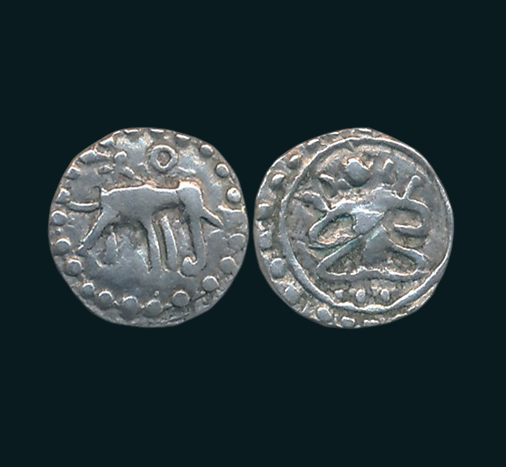
The coin presented here is an interesting anonymous silver issue attributed to the Rashtrakuta dynasty. Weighing 0.45 g, it offers a glimpse into the artistic style and religious symbolism of Rashtrakuta coinage.
The obverse depicts an elephant walking towards the right, with a crescent and moon above it. The elephant was an important symbol of royal authority, military strength and power in ancient Indian traditions. Its prominent depiction on the coin reflects the significance of elephants in royal processions and warfare.
The reverse features a winged Garuda seated in Padmasana (lotus posture) within a circle. Garuda, the divine mount of Lord Vishnu, held special significance in Rashtrakuta royal symbolism and served as the emblem of the dynasty. Its depiction in an anthropomorphic form highlights the religious and political associations of the ruling house.
Both sides of the coin are enclosed within dotted circles, providing a distinct decorative boundary to the designs. Although the issuing ruler remains unidentified, the depiction of Garuda provides an important clue for its attribution to the Rashtrakuta coinage.
-
Gold Varaha-Gadyana, Lion Type Coin of Govinda IV of the Rashtrakutas
2026-11-20 FriThe Rashtrakutas were among the most prominent imperial dynasties of early medieval India, exerci...
-
Goddess Lakshmi in Padmasana Posture on a Rare Kakatiya Gold Gadyana Coin
2026-11-19 ThuThe Kakatiya dynasty was an important ruling power in the Deccan, with its influence centred arou...
-
Chalukyan-style Temple on Gold Gadyana
2026-11-19 ThuThe Chalukyas of Kalyani, also known as the Western Chalukyas, were an influential ruling dynasty...
-
An Interesting Five-Symbols on Punch-Marked Copper Square Karshapana of Eran
2026-11-18 WedThe ancient region of Eran, situated in present-day Madhya Pradesh, was an important centre of ea...
-
Sacred Symbols and Natural Motifs on Post-Mauryan Coinage of the Eran-Vidisha Region
2026-11-18 WedThe decline of the Mauryan Empire in the second century BCE marked the emergence of several regio...