
2026-11-21 Sat
Taxila, known in ancient Indian literature as Takshashila, was one of the most important urban, cultural, educational and commercial centres of the ancient Indian subcontinent. Located in present-day Pakistan's Punjab province, in the historic Gandhara region, Taxila occupied a strategic position at the crossroads of major trade routes connecting the Indian subcontinent with Central and Western Asia. Its historical significance lies not only in its political and economic importance but also in its contribution to the development and spread of religious and cultural traditions.
Taxila flourished from around the 6th century BCE and witnessed the rule of several powerful dynasties and empires, including the Achaemenids, Mauryas, Indo-Greeks, Indo-Scythians, Parthians and Kushans. It came under Mauryan rule during the reign of Chandragupta Maurya and subsequently became an important centre of administration and Buddhist learning under Ashoka. The city was particularly renowned for its educational traditions and attracted students and scholars from different parts of the subcontinent.
Its geographical position facilitated extensive connections with the Gangetic plains, particularly Pataliputra, as well as Mathura, Kashmir, Afghanistan and regions beyond. The ancient routes connecting Taxila with eastern India enabled the movement of merchants, travellers, religious teachers and ideas. Consequently, the city developed a distinctive cultural environment where Indian traditions interacted with Persian, Greek and Central Asian influences.
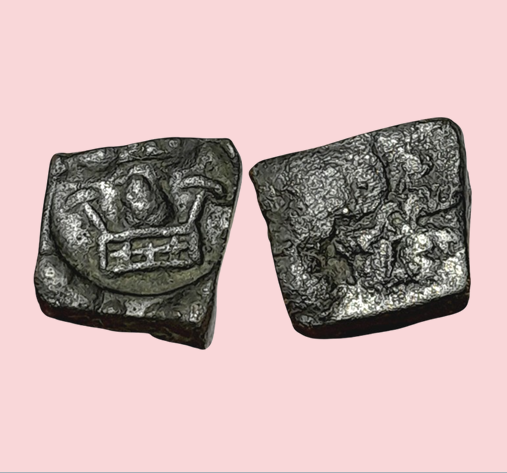
An interesting reflection of this cultural and religious diversity is found in the coinage of Taxila. The representation of a Shivapindi (Shiva Lingam) on an ancient coin is particularly noteworthy. It provides an interesting indication of the presence and significance of Shaivite religious traditions in a region widely celebrated for its Buddhist heritage. The depiction also suggests that the worship of Shiva formed part of the diverse religious landscape of ancient Taxila.
This unusual coin is particularly interesting because of its distinctive religious imagery. The Shivapindi enclosed within a railing may represent a sacred object installed within a protected or designated space, possibly suggesting a shrine or place of worship. Its deeply incised execution makes the central motif especially prominent.
Although the precise date and circumstances of its issuance require further numismatic investigation, this rare and unusual coin offers valuable insight into the religious diversity, artistic expressions and cultural traditions of ancient Taxila.
-
Lion and Elephant Type Copper Drachma of Taxila
2026-11-21 SatIn Continuation, let’s explore another coin of ancient Taxila, we turn our attention to another...
-
Gold Varaha-Gadyana, Lion Type Coin of Govinda IV of the Rashtrakutas
2026-11-20 FriThe Rashtrakutas were among the most prominent imperial dynasties of early medieval India, exerci...
-
Elephant and Garuda on Rashtrakutas Silver Coin
2026-11-20 FriThe Rashtrakutas were one of the most powerful and influential ruling dynasties of early medieval...
-
Goddess Lakshmi in Padmasana Posture on a Rare Kakatiya Gold Gadyana Coin
2026-11-19 ThuThe Kakatiya dynasty was an important ruling power in the Deccan, with its influence centred arou...
-
Chalukyan-style Temple on Gold Gadyana
2026-11-19 ThuThe Chalukyas of Kalyani, also known as the Western Chalukyas, were an influential ruling dynasty...