
2026-11-20 Fri
The Rashtrakutas were among the most prominent imperial dynasties of early medieval India, exercising considerable political and cultural influence across the Deccan between the 8th and 10th centuries CE. Their kingdom reached its greatest territorial extent under several ambitious rulers, who extended their authority through military campaigns, strategic alliances and administrative networks. The dynasty also maintained a rich tradition of coinage, with gold issues displaying distinctive animal motifs, religious symbols and legends in regional scripts.
Govinda IV (c. 930–935 CE) was one of the later rulers of the Rashtrakuta dynasty and the son of Indra III. His reign was marked by political instability and opposition from subordinate chiefs. Although he initially ascended the throne with imperial ambitions, his authority weakened due to internal conflicts and resistance from powerful feudatories. He was eventually displaced by his uncle, Amoghavarsha III. Despite his relatively short reign, Govinda IV remains an interesting figure in Rashtrakuta numismatic history, particularly because of coins bearing his distinctive royal title, Nanni Vedanga.
The gold denomination associated with this coin is known as a Varaha-Gadyana. The term Varaha is derived from the Sanskrit word for boar, the sacred animal form of Lord Vishnu in his third incarnation. The name became associated with gold coinage in South India, where the boar also appeared as a royal emblem on certain coins. Gadyana (also written as Gadya) was a traditional monetary denomination used in South Indian kingdoms and frequently mentioned in inscriptions in connection with payments, donations and religious endowments. Although its precise linguistic derivation is uncertain, it became an established term for a gold monetary unit.
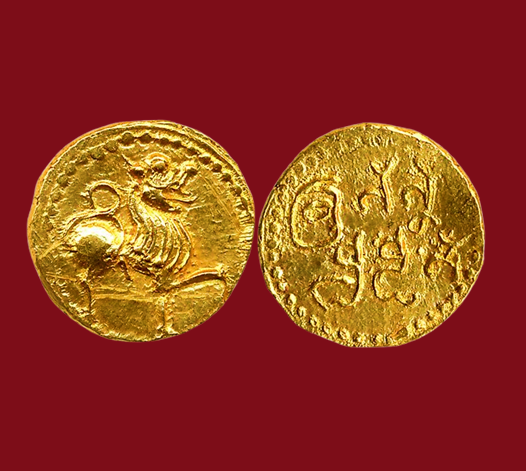
This remarkable gold Varaha-Gadyana of Govinda IV weighs 4.36 g and belongs to the distinctive Lion type. The obverse features a powerful lion facing right, with its tail curled and one of its front paws raised. A plough-like symbol or banner appears to the right of the lion, adding an unusual element to the composition.
The reverse bears the Hale-Kannada legend Sri Nanni Vedanga, arranged in two lines. The inscription is particularly significant as Nanni Vedanga was a royal title associated with Govinda IV. Its identification is supported by epigraphical evidence, making this legend an important clue in attributing the coin to the ruler. The coin type has also been documented in K. Ganesh's Karnataka Coins.
Described as Uncirculated and exceedingly rare, this gold issue is an exceptional example of Rashtrakuta coinage, combining striking animal imagery, regional script and royal titulature.
-
Elephant and Garuda on Rashtrakutas Silver Coin
2026-11-20 FriThe Rashtrakutas were one of the most powerful and influential ruling dynasties of early medieval...
-
Goddess Lakshmi in Padmasana Posture on a Rare Kakatiya Gold Gadyana Coin
2026-11-19 ThuThe Kakatiya dynasty was an important ruling power in the Deccan, with its influence centred arou...
-
Chalukyan-style Temple on Gold Gadyana
2026-11-19 ThuThe Chalukyas of Kalyani, also known as the Western Chalukyas, were an influential ruling dynasty...
-
An Interesting Five-Symbols on Punch-Marked Copper Square Karshapana of Eran
2026-11-18 WedThe ancient region of Eran, situated in present-day Madhya Pradesh, was an important centre of ea...
-
Sacred Symbols and Natural Motifs on Post-Mauryan Coinage of the Eran-Vidisha Region
2026-11-18 WedThe decline of the Mauryan Empire in the second century BCE marked the emergence of several regio...