
2026-11-03 Tue
The Chedi Janapada was one of the sixteen Mahajanapadas of ancient India, which emerged as important political powers during the sixth century BCE. Its territory broadly encompassed parts of present-day Bundelkhand, extending across northern Madhya Pradesh and southern Uttar Pradesh. The ancient kingdom finds mention in Buddhist and Jain literature, as well as in the Mahabharata epic. Its capital was known as Shuktimati, although its precise archaeological identification remains uncertain.
Strategically situated in central India, Chedi occupied an important position along trade and communication routes connecting the Gangetic plains with the Deccan. Its geographical location facilitated commercial and cultural interactions with neighbouring Mahajanapadas, including Vatsa, Avanti and Magadha. Over time, the region witnessed changing political influences as powerful kingdoms expanded their territories.
The coinage attributed to Chedi represents an interesting yet relatively lesser-known chapter in early Indian numismatics. Its silver punch-marked coins generally follow the Karshapana weight standard and display distinctive combinations of animal, geometric and agricultural symbols. These coins commonly feature multiple punches arranged in different configurations, with four-symbol ABCC arrangements among the recorded varieties. Certain issues have also been associated with finds from the Son River Valley, providing valuable evidence for understanding regional monetary circulation.
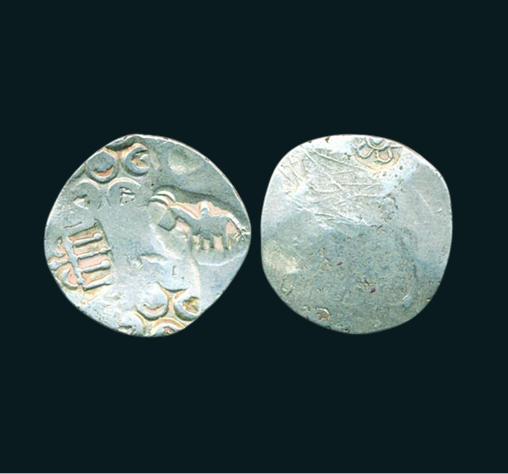
The present specimen is extremely rare and unpublished silver Karshapana attributed to the Chedi Janapada. Weighing 3.32 grams, it features four distinct punches on the obverse arranged in an ABCC configuration.
The first punch depicts a humped bull facing left. The second and third punches display an identical geometric symbol consisting of a central dotted circle surrounded by six semicircles, each containing a dot. The fourth punch depicts a ploughshare accompanied by symbolic representations of oxen through taurine motifs. Its distinctive arrangement also resembles a candelabrum, making it particularly noteworthy.
The reverse carries a single banker’s mark, suggesting subsequent verification during circulation. Mitchiner has listed similar coins featuring a candelabra-like symbol from the Son River Valley. This coin is particularly interesting for its combination of distinctive symbols, its attribution to Chedi and its exceptional state of preservation.
This remarkable coin offers a glimpse into the monetary practices, agricultural symbolism and regional economic networks of early historic central India.
-
Coin of Kurapurika – City State of Narmada Valley
2026-11-03 TueThe Post-Mauryan period witnessed the emergence of several regional powers and independent city-s...
-
Rare Copper Coin of Ardashir I, Kushano-Sasanian
2026-11-02 MonThe Kushano-Sasanian period represents an important chapter in the history of Central Asia and th...
-
Punch-Marked Copper Coin of the Anga Mahajanapada
2026-11-02 MonThe Anga Mahajanapada was one of the sixteen great territorial states that flourished in ancient ...
-
Silver Adivaraha Dramma of Bhoja I, Gurjara Pratiharas
2026-10-30 FriThe Gurjara Pratiharas were among the most powerful dynasties of early medieval India, playing a ...
-
Gold Uniface Coin of Nandanaraja of the Nala Dynasty
2026-10-29 ThuThe gold coinage of ancient Dakshina Kosala offers valuable insights into the political history, ...