
2026-11-02 Mon
The Kushano-Sasanian period represents an important chapter in the history of Central Asia and the northwestern Indian subcontinent. Emerging during the third century CE, the Kushano-Sasanian rulers established their authority over territories that had formerly belonged to the Kushan Empire, including parts of present-day Afghanistan, eastern Iran, Bactria and Gandhara. Following the expansion of the Sasanian Empire under its early rulers, these territories came under Sasanian political influence. Local rulers, known as the Kushanshahs or Kings of the Kushans, governed these regions while acknowledging the broader authority of the Sasanian imperial dynasty.
The Kushano-Sasanians developed a distinctive political and cultural identity by combining Sasanian royal traditions with established Kushan artistic and religious influences. Their coinage is particularly important for reconstructing their history, as it reflects their rulers, political authority, religious beliefs and cultural interactions. They issued gold, silver and copper coins, often featuring royal portraits on the obverse and divine figures on the reverse. Although their chronology and succession remain subjects of scholarly debate, their coinage provides valuable evidence of their rule between the third and fourth centuries CE.
Among the notable rulers associated with this period was Ardashir I Kushanshah, whose coinage represents an early phase of Kushano-Sasanian monetary traditions. He should be distinguished from Ardashir I, the founder of the Sasanian Empire (r. 224–240 CE). The Kushanshah rulers adopted Sasanian royal names and titles while retaining elements of the earlier Kushan political and artistic traditions. Ardashir I's coins are particularly interesting for their distinctive representation of divine figures, reflecting the religious and cultural diversity of the region. The precise chronology of his reign remains debated among numismatists.
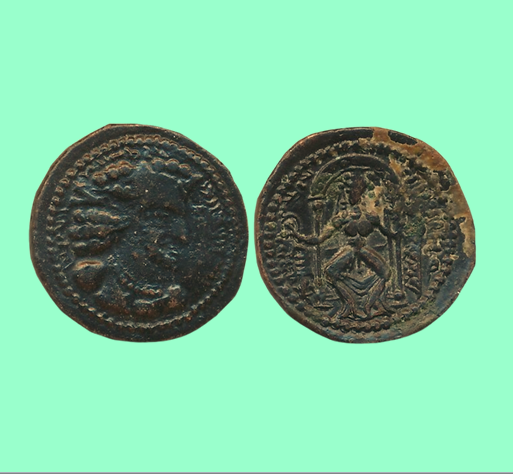
This coin is a copper coin weighing 3.15 grams, attributed to Ardashir I of the Kushano-Sasanian tradition. The obverse depicts the bust of the king facing right, portrayed frontally, and wearing a close-fitting crown and an earring. The royal portrait follows Sasanian conventions of depicting the ruler through distinctive headgear and personal ornaments, while retaining the regional characteristics of Kushano-Sasanian craftsmanship.
The reverse features the goddess Anahita (Anahid) seated facing forward within an arched shrine. She holds a diadem with long flowing ribbons in her outstretched right hand and a sceptre in her left. Anahita was an important Iranian goddess associated with water, fertility and prosperity, and her representation reflects the influence of Iranian religious traditions in the region. The frontal seated deity within an architectural setting is particularly noteworthy, as this composition represents an innovative feature of early Kushano-Sasanian copper coinage rather than a direct imitation of conventional Sasanian or earlier Kushan designs.
This coin is a fascinating example of the cultural synthesis that characterised Kushano-Sasanian rule. Through its royal portrait and divine imagery, it illustrates the interaction of Kushan and Sasanian artistic traditions and offers valuable insights into the political and religious landscape of ancient Central Asia.
-
Rare Silver Punch-Marked Coin of the Chedi Janapada
2026-11-03 TueThe Chedi Janapada was one of the sixteen Mahajanapadas of ancient India, which emerged as import...
-
Coin of Kurapurika – City State of Narmada Valley
2026-11-03 TueThe Post-Mauryan period witnessed the emergence of several regional powers and independent city-s...
-
Punch-Marked Copper Coin of the Anga Mahajanapada
2026-11-02 MonThe Anga Mahajanapada was one of the sixteen great territorial states that flourished in ancient ...
-
Silver Adivaraha Dramma of Bhoja I, Gurjara Pratiharas
2026-10-30 FriThe Gurjara Pratiharas were among the most powerful dynasties of early medieval India, playing a ...
-
Gold Uniface Coin of Nandanaraja of the Nala Dynasty
2026-10-29 ThuThe gold coinage of ancient Dakshina Kosala offers valuable insights into the political history, ...