
2026-11-03 Tue
The Post-Mauryan period witnessed the emergence of several regional powers and independent city-states across central India. Among these was Kurapurika, an ancient city-state associated with the Avanti region and the Narmada Valley. It is believed to have flourished around the second century BCE, when local urban centres increasingly asserted their political and economic identities through the issuance of their own coinage.
The ancient city of Purika, identified with Kurapurika, is traditionally associated with the region near Mahishmati, on the banks of the Narmada River. According to the historical identification proposed by John Fleet, Purika was situated south of the island of Mahishmati (modern Mandhata, near Omkareshwar in Madhya Pradesh). However, its precise archaeological location remains uncertain. The discovery of Kurapurika coins in the Eran-Vidisha region and other parts of central India has provided valuable evidence of its wider commercial connections. Numismatic scholar Prashant P. Kulkarni has also highlighted the importance of coin finds from the Narmada Valley in understanding this relatively lesser-known city-state.
Kurapurika issued both inscribed and uninscribed coins, primarily in copper and bronze, with certain issues also struck in bell metal. The inscribed varieties carry Brahmi legends identifying the issuing authority as 'Kurapurika'. Their designs feature a variety of religious, geometric and natural motifs, including trees within railings, animals, Ujjain symbols and boats. The recurring depiction of boats is particularly interesting, suggesting the significance of river-based transportation and commercial activities in the Narmada Valley.
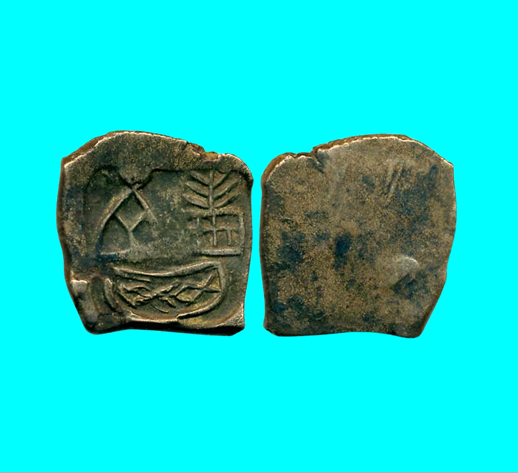
Here, the coin is an interesting example of the uninscribed bronze coinage attributed to Kurapurika in Eastern Malwa. Weighing 7.97 grams, it is a uniface issue, with its entire design represented on the obverse. The principal motif consists of a three-arched chaitya or hill surmounted by a crescent, a familiar symbol in the coinage of ancient India. A tree enclosed within a railing appears alongside it, representing an important element of early Indian religious and artistic symbolism. At the bottom of the composition is a boat, an especially significant feature considering Kurapurika's association with the Narmada Valley.
Although the coin carries no inscription, its distinctive combination of symbols provides valuable evidence of the artistic conventions, cultural influences and economic activities of the period. Such civic issues offer fascinating insights into the political and commercial life of smaller urban centres that played an important role in India's ancient history.
-
Rare Silver Punch-Marked Coin of the Chedi Janapada
2026-11-03 TueThe Chedi Janapada was one of the sixteen Mahajanapadas of ancient India, which emerged as import...
-
Rare Copper Coin of Ardashir I, Kushano-Sasanian
2026-11-02 MonThe Kushano-Sasanian period represents an important chapter in the history of Central Asia and th...
-
Punch-Marked Copper Coin of the Anga Mahajanapada
2026-11-02 MonThe Anga Mahajanapada was one of the sixteen great territorial states that flourished in ancient ...
-
Silver Adivaraha Dramma of Bhoja I, Gurjara Pratiharas
2026-10-30 FriThe Gurjara Pratiharas were among the most powerful dynasties of early medieval India, playing a ...
-
Gold Uniface Coin of Nandanaraja of the Nala Dynasty
2026-10-29 ThuThe gold coinage of ancient Dakshina Kosala offers valuable insights into the political history, ...