
2026-10-29 Thu
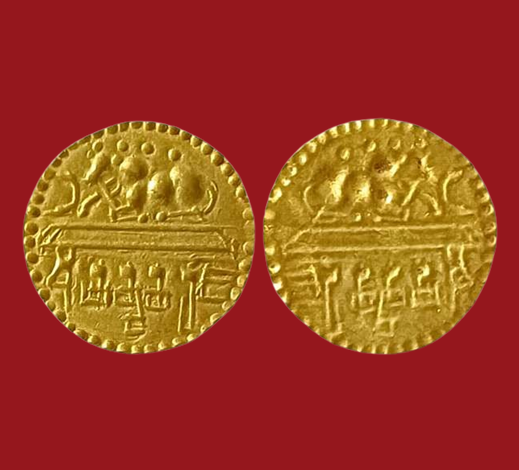
The gold coinage of ancient Dakshina Kosala offers valuable insights into the political history, artistic traditions and religious symbolism of central India. Among its fascinating issues is a rare gold coin attributed to Nandanaraja of the Nala dynasty of Pushkari. Weighing 1.30 grams, this distinctive coin features a seated bull and a legend in box-headed Brahmi script, reflecting the region’s unique numismatic traditions.
The Nala dynasty emerged as an influential regional power in parts of central India, particularly in areas corresponding to present-day Chhattisgarh and adjoining regions of Odisha and Maharashtra. Its history is associated with ancient Pushkari, generally identified with a site near modern Podagada in Odisha. The dynasty flourished during the fifth and sixth centuries AD, a period marked by shifting political alliances and competition among regional kingdoms following the decline of Gupta imperial authority.
The Nalas extended their influence across portions of the Bastar region and neighbouring territories. Their history is reconstructed primarily through inscriptions, archaeological discoveries and coins. Rulers such as Varaharaja, Bhavadattavarman and Skandavarman are associated with the dynasty’s political development, while their inscriptions provide evidence of royal patronage and religious traditions. The Nalas maintained connections with the wider cultural world of ancient India while developing distinctive regional expressions of kingship and artistic identity.
Nandanaraja is among the lesser-known rulers associated with the Nala dynasty. Unlike Bhavadattavarman and Arthapati, whose names are also recorded in inscriptions, Nandanaraja is principally known through his rare gold coins. His precise chronology and individual achievements remain uncertain, although his coinage is generally attributed to the fifth or sixth century AD. These issues provide important evidence of the dynasty’s monetary practices and royal identity.
The obverse depicts a bull seated in a couchant position upon a pedestal, accompanied by a torque or crescent-shaped symbol to its left. Beneath the principal design, the legend Shri Nandanaraja appears in distinctive box-headed Brahmi letters. The reverse carries an intaglio impression of the obverse design, a characteristic feature of the repoussé manufacturing technique.
The bull-and-crescent motif is particularly significant in Nala coinage, distinguishing these issues from the designs of several contemporary dynasties. The bull may be interpreted within the broader religious and cultural traditions of ancient India, where it held associations with strength, fertility and sacred authority. Its possible Shaiva associations are noteworthy, although the precise intended meaning of the motif on this coin cannot be established conclusively. The crescent or torque-like symbol adds another distinctive element to the composition.
The coin was produced by striking a thin gold planchet against an engraved die, creating a raised design on the obverse and its corresponding recessed impression on the reverse. This unusual technique demonstrates the specialised craftsmanship employed by the Nalas.
-
Rare Gold Bracteate of Mahendraditya of the Sarabhapurias of Mahakosala
2026-10-29 ThuThe Sarabhapurias emerged as a regional ruling dynasty in Mahakosala, a historical region corresp...
-
Lord Shiva on Kidarite Huns Gold Dinar – Influence of Indian Tradition on Central Asia
2026-10-28 WedThe Kidarite Huns were a Central Asian ruling dynasty that emerged during the late fourth and fif...
-
Rare Bronze Coin from Taxila of Indo-Scythian King Maues
2026-10-27 TueThe Indo-Scythians were groups of Saka peoples who migrated from Central Asia into the northweste...
-
Uninscribed Die-Struck Copper Coin of the Biface Symbolic Series of Post-Mauryan Taxila
2026-10-27 TueTaxila, located in present-day Punjab province of Pakistan, was one of the most important urban c...
-
Gold Varaha-Gadyana of Govinda IV, Rashtrakutas
2026-10-26 MonThe Rashtrakutas were among the most influential dynasties of early medieval India, exercising im...