
2026-11-02 Mon
The Anga Mahajanapada was one of the sixteen great territorial states that flourished in ancient India during the sixth century BCE. Located in the eastern part of present-day Bihar, extending towards parts of present-day West Bengal, Anga occupied an important position in the political and commercial history of the Indian subcontinent. Its capital was Champa, generally identified with the region near modern-day Bhagalpur in Bihar. Situated along the Ganga River, Champa developed into a prosperous centre of trade and commerce, with connections extending to other important urban centres of ancient India.
Anga frequently came into conflict with its powerful western neighbour, Magadha. According to Buddhist literary traditions, King Bimbisara of Magadha conquered Anga and incorporated it into his expanding kingdom. This marked an important stage in the political consolidation of eastern India. Anga is also mentioned in Buddhist and Jain literature, highlighting its significance as an important centre of early urbanisation, trade and cultural activity.
The coinage attributed to Anga provides valuable insights into the monetary practices of this region during the early historic period. Punch-marked coins represent some of the earliest forms of currency used in ancient India. Unlike die-struck coins, they were manufactured by cutting metal blanks into suitable shapes and applying individual punches bearing distinctive symbols. These symbols often represented religious beliefs, natural elements and regional monetary traditions.
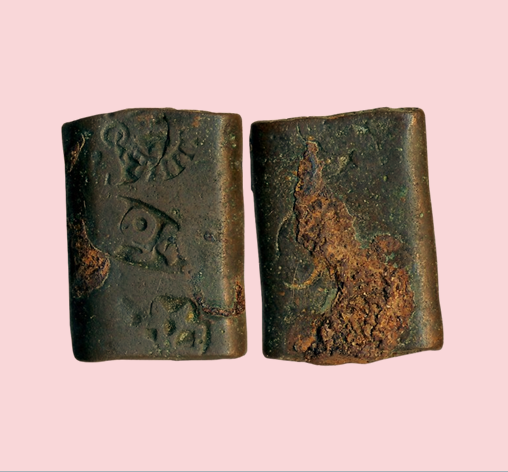
The present coin is a copper punch-marked coin weighing 15.25 grams, attributed to the Anga Mahajanapada and belonging to the South Bihar regional series. Its most striking feature is the presence of multiple symbols punched on both sides of the coin. These include the Sun, an arched hill, the Nandyavarta and other distinctive motifs. The Sun symbol, frequently encountered on early Indian coinage, is associated with celestial and cosmic significance. The arched hill motif is a recurring element in ancient Indian numismatic art, while the Nandyavarta, an auspicious geometric symbol, holds significance in ancient Indian religious traditions.
The arrangement of these symbols reflects the distinctive artistic and monetary conventions of early regional coinage. Unlike later coins featuring royal portraits or inscriptions, punch-marked issues relied primarily on symbolic representations for their identification and circulation.
This coin is an important numismatic testimony to the monetary traditions of eastern India, offering a glimpse into the economic activity, artistic expression and cultural symbolism of the Anga Mahajanapada.
-
Rare Silver Punch-Marked Coin of the Chedi Janapada
2026-11-03 TueThe Chedi Janapada was one of the sixteen Mahajanapadas of ancient India, which emerged as import...
-
Coin of Kurapurika – City State of Narmada Valley
2026-11-03 TueThe Post-Mauryan period witnessed the emergence of several regional powers and independent city-s...
-
Rare Copper Coin of Ardashir I, Kushano-Sasanian
2026-11-02 MonThe Kushano-Sasanian period represents an important chapter in the history of Central Asia and th...
-
Silver Adivaraha Dramma of Bhoja I, Gurjara Pratiharas
2026-10-30 FriThe Gurjara Pratiharas were among the most powerful dynasties of early medieval India, playing a ...
-
Gold Uniface Coin of Nandanaraja of the Nala Dynasty
2026-10-29 ThuThe gold coinage of ancient Dakshina Kosala offers valuable insights into the political history, ...