
2026-10-27 Tue
Taxila, located in present-day Punjab province of Pakistan, was one of the most important urban centres of the ancient Indian subcontinent. Strategically positioned along major trade routes connecting the Indian subcontinent with Central Asia and regions farther west, it flourished as a centre of commerce, craftsmanship, and cultural exchange. Its history reflects the successive influence of the Achaemenids, Mauryas, Indo-Greeks, Sakas, and other regional powers.
Under the Mauryan Empire, particularly during the reign of Ashoka in the third century BCE, Taxila formed part of a vast political and administrative network. Following the decline of Mauryan authority, the region experienced political fragmentation and the emergence of local authorities, alongside the influence of Indo-Greek and later Central Asian rulers. This changing political landscape is reflected in the coinage of Taxila, which includes a fascinating variety of local issues, often distinguished by their distinctive symbols and manufacturing techniques.
The local coinage of post-Mauryan Taxila provides valuable evidence of regional monetary traditions. Unlike coins bearing explicit royal names or portraits, many issues relied on symbolic imagery, offering a glimpse into the visual language and cultural practices of their issuing authorities.
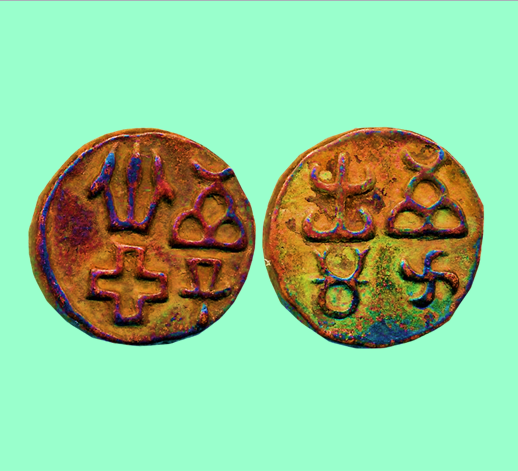
This remarkable uninscribed copper coin belongs to the Biface Series – Symbolic Type of local Taxila coinage, generally dated to approximately 200–150 BCE. Weighing 11.15 grams, it is a heavy copper issue distinguished by its carefully arranged symbols on both faces. Unlike punch-marked coins, whose individual motifs were applied using separate punches, this coin was produced through die-striking, allowing a coordinated arrangement of designs on both sides.
The obverse displays four symbols arranged clockwise from the upper left: a spear or standard decorated with ribbons, a three-arched chaitya crowned by a crescent, a triangle-headed standard, and an open cross. Together, these motifs create a distinctive symbolic composition characteristic of early regional coinage. The three-arched chaitya, frequently encountered on ancient northwestern Indian coins, is a particularly recognisable element of Taxila's numismatic repertoire.
The reverse features another group of four symbols, also arranged clockwise from the upper left: Shrivatsa, a three-arched chaitya with a crescent, a swastika, and Nandipada. These motifs formed part of the wider symbolic vocabulary of ancient South Asian coinage. Their precise meanings in this particular issue remain uncertain, and they should not necessarily be interpreted as having one uniform religious or political significance.
The coin weighs 7.05 grams and shares the same principal symbolic arrangement. The heavier specimen offers an important opportunity to examine variation within this distinctive series. Its deep, bold strike preserves the designs with impressive clarity, while the natural patination enhances its antique character. Described as about uncirculated, the coin is exceptionally well preserved for its type, making its condition particularly noteworthy.
This rare Taxila copper issue is more than a monetary artefact: it represents the artistic conventions, technical capabilities, and regional identity of a dynamic post-Mauryan urban centre. Its combination of elaborate symbolism, substantial weight, and exceptional preservation makes it a significant specimen for collectors and researchers interested in the early coinage of ancient northwestern India.
-
Rare Bronze Coin from Taxila of Indo-Scythian King Maues
2026-10-27 TueThe Indo-Scythians were groups of Saka peoples who migrated from Central Asia into the northweste...
-
Gold Varaha-Gadyana of Govinda IV, Rashtrakutas
2026-10-26 MonThe Rashtrakutas were among the most influential dynasties of early medieval India, exercising im...
-
The Lion and the Conch on the Vishnukundins of Vengi’s Coinage
2026-10-26 MonThe Vishnukundins emerged as a powerful dynasty in the eastern Deccan during the fifth and sixth ...
-
Goddess Laxmi holding Lotus and feeding Peacock on the Kumargupta I’s Gold Coin
2026-10-23 FriThe Gupta Empire (4th–6th centuries CE) occupies a distinguished place in Indian history, renow...
-
Chola Influence on Sri Lankan Coinage through Gold Kahavanu
2026-10-23 FriThe history of Sri Lankan coinage offers fascinating insights into the political, commercial and ...