
2026-10-28 Wed
The Kidarite Huns were a Central Asian ruling dynasty that emerged during the late fourth and fifth centuries CE. They established their authority over parts of Bactria, the Hindu Kush region and Gandhara, playing an important role in the political transformation of the northwestern Indian subcontinent. Often classified among the Iranian Huns, the Kidarites were distinct from the Huns who invaded Europe. Their history is reconstructed through literary accounts, inscriptions and, particularly, their coinage.
The dynasty derives its name from Kidara, a ruler associated with the expansion of Kidarite power into former Kushan territories. During the fifth century, the Kidarites challenged the Kushano-Sasanians, inheriting established administrative practices and monetary traditions. Their territories included parts of present-day Afghanistan and northwestern Pakistan, with their influence extending into regions bordering northern India.
The Kidarites contributed to Indian history through their political expansion, continuation of earlier coinage traditions and interaction with local cultures. Their coins reveal the blending of Central Asian political authority, Sasanian royal imagery and Indian religious symbolism. Their rule was eventually challenged by rival powers, particularly the Hephthalites, who displaced them from important Central Asian territories.
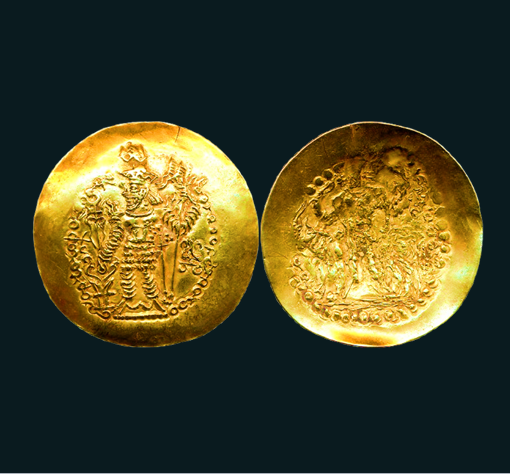
This remarkable gold dinar weighs 7.55 grams and attributed to a Bactrian mint. Described as being in Extremely Fine condition, it reflects the artistic conventions of the Kushano-Sasanian monetary tradition and the religious imagery prevalent in the region.
The obverse of the coin depicts king appears wearing Sasanian-style attire and a crown, holding a sword and trident while making an offering at a fire altar. A Bactrian inscription surrounds the design. The royal costume and fire altar reflect the influence of Sasanian political and religious traditions, which continued under successive rulers of Bactria.
The reverse of the coin shows Lord Shiva stands facing forward, holding a diadem and trident, while Nandi, his sacred bull, stands to the left. The scene is enclosed within a dotted border. Shiva's trident and the presence of Nandi identify the deity and connect the coin with the religious traditions of the Indian subcontinent.
The coin's attribution is particularly noteworthy because it bears the name Varahran, associated with the Kushano-Sasanian royal tradition. The Kidarites inherited and adapted earlier coin designs, sometimes retaining established royal names and imagery. Therefore, the attribution of this particular issue should be understood in the context of its catalogue classification rather than assumed solely from its design.
This gold dinar provides valuable evidence of cultural interaction in ancient Bactria, where Central Asian rulers adopted established monetary conventions while retaining imagery meaningful to the region's diverse communities.
The coin stands as a testament to the interconnected histories of Central Asia and India, preserving in gold the legacy of royal authority, artistic continuity and religious symbolism.
-
Rare Bronze Coin from Taxila of Indo-Scythian King Maues
2026-10-27 TueThe Indo-Scythians were groups of Saka peoples who migrated from Central Asia into the northweste...
-
Uninscribed Die-Struck Copper Coin of the Biface Symbolic Series of Post-Mauryan Taxila
2026-10-27 TueTaxila, located in present-day Punjab province of Pakistan, was one of the most important urban c...
-
Gold Varaha-Gadyana of Govinda IV, Rashtrakutas
2026-10-26 MonThe Rashtrakutas were among the most influential dynasties of early medieval India, exercising im...
-
The Lion and the Conch on the Vishnukundins of Vengi’s Coinage
2026-10-26 MonThe Vishnukundins emerged as a powerful dynasty in the eastern Deccan during the fifth and sixth ...
-
Goddess Laxmi holding Lotus and feeding Peacock on the Kumargupta I’s Gold Coin
2026-10-23 FriThe Gupta Empire (4th–6th centuries CE) occupies a distinguished place in Indian history, renow...