
2026-10-29 Thu
The Sarabhapurias emerged as a regional ruling dynasty in Mahakosala, a historical region corresponding broadly to parts of present-day Chhattisgarh and adjoining areas. Their political ascendancy occurred during a period of considerable transformation following the decline of Gupta imperial authority. As regional powers asserted greater independence, the Sarabhapurias established their influence across parts of central India.
The dynasty is generally associated with the rulers Sharabha, Narendra, Prasannamatra, and their successors, whose inscriptions illuminate the political and religious landscape of the period. Their patronage of Hindu traditions, particularly Vaishnavism, is reflected in their inscriptions and coinage. The adoption of Sanskrit and Brahmi script further demonstrates their participation in the cultural conventions prevalent among contemporary Indian ruling houses.
Mahendraditya remains an intriguing figure because comparatively little is known about his individual reign from surviving inscriptions. His importance lies chiefly in the evidence provided by his distinctive gold coinage, which reflects the dynasty’s religious affiliations and artistic sophistication. The precise chronology of his rule and the extent of his political achievements remain uncertain.
The Sarabhapuriya gold issues demonstrate the influence of contemporary Gupta monetary traditions while exhibiting a distinctive regional character. Their rulers adopted Vaishnava imagery, prominently featuring Garuda, the divine mount of Lord Vishnu. These coins were produced using the repousse technique, in which a design is raised by working the metal from the reverse.
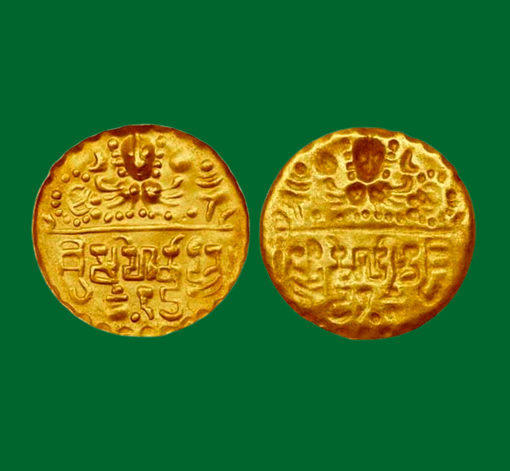
This remarkable coin is particularly noteworthy for its broad flan, shallow bowl-shaped (scyphate) profile and deeply impressed design. The obverse of the coin depicts Garuda facing forward, flanked by a Shankha (conch shell) and a Chakra (discus), symbols associated with Lord Vishnu.
A legend in Brahmi script appears beneath the central motif, identifying the ruler as Mahendraditya. The reverse is uniface, characteristic of these repousse bracteates.
For decades, coins bearing the title Mahendraditya were attributed to Gupta emperor Kumaragupta I, who also used this epithet. Subsequent numismatic scholarship proposed a Sarabhapuriya attribution, although the classification and precise historical association of these issues have remained subjects of scholarly discussion.
Weighing just 1.26 grams, this specimen is significant not merely for its rarity but also for the historical questions it raises. Its distinctive manufacturing technique, Vaishnava symbolism and royal legend offer valuable evidence for understanding regional coinage in post-Gupta India. As a rare surviving issue associated with Mahendraditya, it represents an important addition to the study of ancient Indian numismatics.
-
Gold Uniface Coin of Nandanaraja of the Nala Dynasty
2026-10-29 ThuThe gold coinage of ancient Dakshina Kosala offers valuable insights into the political history, ...
-
Lord Shiva on Kidarite Huns Gold Dinar – Influence of Indian Tradition on Central Asia
2026-10-28 WedThe Kidarite Huns were a Central Asian ruling dynasty that emerged during the late fourth and fif...
-
Rare Bronze Coin from Taxila of Indo-Scythian King Maues
2026-10-27 TueThe Indo-Scythians were groups of Saka peoples who migrated from Central Asia into the northweste...
-
Uninscribed Die-Struck Copper Coin of the Biface Symbolic Series of Post-Mauryan Taxila
2026-10-27 TueTaxila, located in present-day Punjab province of Pakistan, was one of the most important urban c...
-
Gold Varaha-Gadyana of Govinda IV, Rashtrakutas
2026-10-26 MonThe Rashtrakutas were among the most influential dynasties of early medieval India, exercising im...