
2026-10-27 Tue
The Indo-Scythians were groups of Saka peoples who migrated from Central Asia into the northwestern Indian subcontinent. They are called Indo-Scythians because they brought their political and cultural traditions into territories encompassing present-day Pakistan and parts of northwestern India. Their migration was connected with movements of Central Asian peoples, including pressure from the Yuezhi, which contributed to the displacement of the Sakas from their earlier homelands.
From approximately the second century BCE, these groups entered regions previously influenced by the Indo-Greek kingdoms. Their arrival did not simply replace Greek traditions; instead, it produced a distinctive cultural synthesis reflected in political institutions, artistic styles, religious imagery, and coinage. Taxila, an important centre of trade and administration in ancient Gandhara, became one of the principal regions associated with Indo-Scythian rule.
Maues, also known as Moga in some historical and epigraphic contexts, is generally regarded as the earliest major Indo-Scythian king in the northwestern subcontinent. His reign is commonly placed around the late second to early first century BCE, although the precise chronology remains debated.
Maues established his authority across territories that included parts of Gandhara, Taxila, and the northwestern frontier regions, with connections to Kashmir and Hazara. His rule marked an important stage in the development of Indo-Scythian political power. Rather than eliminating every Indo-Greek ruler, he appears to have governed alongside some contemporary Greek-identified kings, suggesting a complex political environment involving regional alliances and overlapping territories.
Maues' coinage reflects this multicultural setting. He issued coins in silver and copper, employing Greek legends and Hellenistic designs alongside local symbols and familiar regional motifs. Some of his larger silver coins used the titles Basileos Basileon Megalou Mauou, meaning “of the Great King of Kings Maues,” alongside an Indic-language equivalent in Kharosthi script. His bronze issues featured a variety of animals, deities, and symbols, demonstrating the diversity of artistic influences within his kingdom.
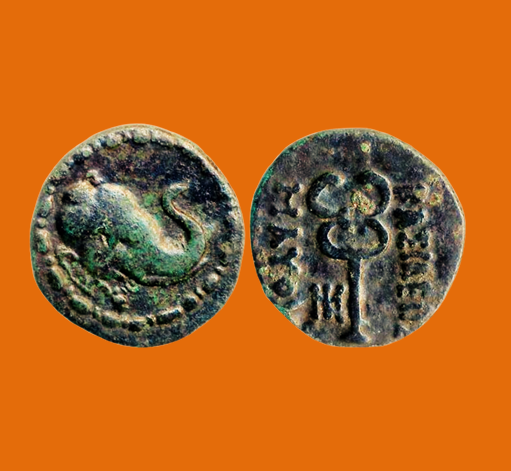
This bronze coin of Maues weighs 8.58 grams and is attributed to Taxila, one of the important centres of his monetary activity.
The obverse depicts an elephant's head facing right. The elephant was an established motif in the region's earlier coinage and continued under Maues, illustrating the persistence of local artistic traditions.
On the reverse, a caduceus—a staff entwined by two serpents—occupies the central field, accompanied by the Greek legend “BASILEOS MAYOY,” meaning “of King Maues,” and a monogram to the left. The Greek inscription reflects the enduring influence of Hellenistic monetary conventions in the northwestern subcontinent.
This coin offers a fascinating glimpse into the political and cultural world of Maues. Its combination of elephant imagery, Greek lettering, and classical symbolism makes it a noteworthy artefact of the Indo-Scythian period and an important addition to the study of ancient Taxila's numismatic heritage.
-
Uninscribed Die-Struck Copper Coin of the Biface Symbolic Series of Post-Mauryan Taxila
2026-10-27 TueTaxila, located in present-day Punjab province of Pakistan, was one of the most important urban c...
-
Gold Varaha-Gadyana of Govinda IV, Rashtrakutas
2026-10-26 MonThe Rashtrakutas were among the most influential dynasties of early medieval India, exercising im...
-
The Lion and the Conch on the Vishnukundins of Vengi’s Coinage
2026-10-26 MonThe Vishnukundins emerged as a powerful dynasty in the eastern Deccan during the fifth and sixth ...
-
Goddess Laxmi holding Lotus and feeding Peacock on the Kumargupta I’s Gold Coin
2026-10-23 FriThe Gupta Empire (4th–6th centuries CE) occupies a distinguished place in Indian history, renow...
-
Chola Influence on Sri Lankan Coinage through Gold Kahavanu
2026-10-23 FriThe history of Sri Lankan coinage offers fascinating insights into the political, commercial and ...