
2026-10-26 Mon
The Vishnukundins emerged as a powerful dynasty in the eastern Deccan during the fifth and sixth centuries CE, ruling territories across parts of present-day Andhra Pradesh and Telangana. Their political influence expanded as earlier powers declined, and their rulers played an important role in shaping the region’s early medieval history. Their coinage, particularly the distinctive lion types, provides valuable evidence of the artistic traditions and political symbolism of the period.
The Vishnukundins’ history was closely connected with that of the Pallavas, whose power centred on Kanchipuram in present-day Tamil Nadu. Both dynasties competed for control over strategically important territories, especially the fertile, paddy-rich heartlands of coastal Andhra. These agricultural regions offered considerable economic resources and political advantages. Their rivalry forms an important backdrop to the study of their coinage, as similarities in monetary fabric and design may reflect cultural interaction, regional circulation, or shared minting traditions.
The lion was a prominent motif in early South Indian coinage, symbolising strength, authority, and sovereignty. The Vishnukundins issued coins depicting a powerful, roaring lion, while the Pallavas also employed lion imagery alongside other designs, including their well-known bull types. Lion motifs appeared in the coinage of other regional dynasties as well, demonstrating the widespread appeal of this powerful symbol.
Vishnukundin lion-type coins commonly feature a lion facing right, often with a raised foreleg and a distinctive tail, accompanied on the reverse by religious or decorative symbols. Some varieties are associated with the Shrivatsa symbol, while others display a conch shell or different motifs. The Eastern Chalukyas of Vengi subsequently continued aspects of the region’s earlier monetary traditions, including the use of animal imagery. Since many Vishnukundin coins are uninscribed, their attribution relies heavily on iconography, fabric, metallic composition, and comparisons with related coinage.
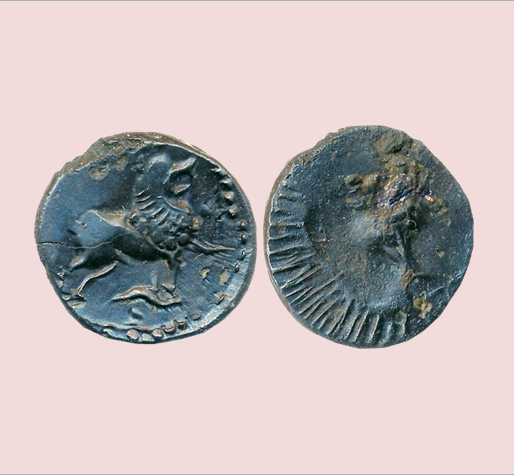
This uninscribed alloyed copper coin, weighing 6.17 grams, is an exceptional example attributed to the Vishnukundins of Vengi. Graded About Extremely Fine and described as extremely rare, it is distinguished by its bold animal imagery and religious symbolism.
The obverse depicts a roaring, maned lion facing right within a dotted circle. Its expressive posture highlights the animal’s association with power and authority. The reverse features a conch shell, or Shankha, enclosed within a rayed circle. The conch holds religious significance, particularly in the worship of Vishnu, adding a devotional dimension to the coin’s visual design.
Notably, the coin’s fabric and metallic composition closely resemble those of Pallava issues. This similarity raises the possibility that it was struck at a southern mint located closer to Pallava territories. Although this remains a plausible hypothesis rather than a confirmed attribution, it offers an intriguing perspective on the monetary connections between neighbouring kingdoms.
With its distinctive lion-and-conch design, uninscribed surfaces, and extreme rarity, this coin offers a fascinating glimpse into the numismatic heritage of the Vishnukundins and the complex political landscape of early medieval South India.
-
Gold Varaha-Gadyana of Govinda IV, Rashtrakutas
2026-10-26 MonThe Rashtrakutas were among the most influential dynasties of early medieval India, exercising im...
-
Goddess Laxmi holding Lotus and feeding Peacock on the Kumargupta I’s Gold Coin
2026-10-23 FriThe Gupta Empire (4th–6th centuries CE) occupies a distinguished place in Indian history, renow...
-
Chola Influence on Sri Lankan Coinage through Gold Kahavanu
2026-10-23 FriThe history of Sri Lankan coinage offers fascinating insights into the political, commercial and ...
-
Bronze Coin of Zeionises, Kshatrapa of Chuksa
2026-10-22 ThuThe Indo-Scythians, also known as the Sakas, were Central Asian peoples who migrated into the nor...
-
Silver Drachma of the Western Kshatrapas Ruler Viradaman
2026-10-22 ThuThe Western Kshatrapas were an important dynasty that ruled parts of western and central India, p...