
2026-10-23 Fri
The Gupta Empire (4th–6th centuries CE) occupies a distinguished place in Indian history, renowned for its political expansion, cultural achievements and artistic excellence. Its coinage, particularly its gold dinars, represents one of the finest expressions of ancient Indian minting traditions. Gupta rulers employed coins not merely as instruments of monetary exchange but also as a medium to proclaim royal authority, military prowess, religious beliefs and personal accomplishments.
The gold coinage of the early Guptas developed under Chandragupta I and reached remarkable artistic heights during the reign of Samudragupta (c. 335–375 CE). Chandragupta II (c. 375–415 CE) further expanded the empire's coinage repertoire, issuing gold coins depicting the king as an archer, horseman and lion-slayer, among other types. These coins commonly featured the ruler on the obverse and a deity, frequently Goddess Lakshmi, on the reverse. Their Sanskrit legends, written in Brahmi script, celebrated royal victories and distinguished titles.
The Gupta gold dinars generally weighed around eight grams, although variations occurred across different types and reigns. Their carefully modelled figures, elaborate costumes, ceremonial equipment and finely engraved inscriptions reveal the sophistication of Gupta craftsmanship.
Kumaragupta I, who ruled approximately from 415 to 455 CE, succeeded Chandragupta II and continued the imperial traditions established by his predecessors. Known by the title Mahendraditya, he presided over a period in which Gupta political authority, religious patronage and artistic production remained influential.
Kumaragupta I issued a diverse range of gold coins, including Archer, Horseman, Lion-slayer, Tiger-slayer, Elephant-rider and other distinctive types. These designs reflected the martial identity of the king while also revealing his interest in religious and symbolic imagery. His coinage is particularly notable for variations in the depiction of the royal figure and the goddess on the reverse.
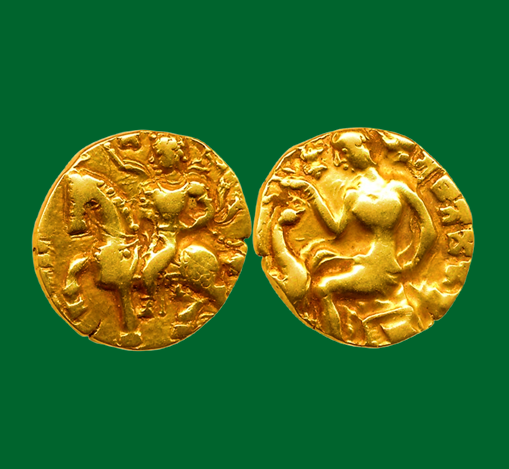
The obverse of the coin portraits the king is riding a richly caparisoned horse facing left, holding a bow in his hand. The horse's ceremonial adornments and the ruler's posture lend the composition a sense of movement and royal dignity. A Brahmi inscription runs around the periphery, although only portions of the legend remain legible, with traces of additional letters visible in the exergue. The equestrian image projects the king's martial identity and authority.
The reverse depicts a goddess, commonly identified as Lakshmi in the Horseman series, is seated in profile on a stool. She holds a lotus, a traditional symbol of beauty, purity and prosperity, while feeding a peacock. To her right appears the Brahmi legend Ajitamahendra, meaning approximately “Unconquered Mahendra.” The title connects the coin's imagery with Kumaragupta I's royal identity and the imperial language of victory.
The peacock is a particularly interesting feature of Kumaragupta I's coinage. It appears in several designs associated with his reign, reflecting the emperor's distinctive artistic preferences and the importance of birds in Gupta visual symbolism. The combination of the goddess, lotus and peacock creates a graceful counterpoint to the armed horseman on the opposite side.
-
Chola Influence on Sri Lankan Coinage through Gold Kahavanu
2026-10-23 FriThe history of Sri Lankan coinage offers fascinating insights into the political, commercial and ...
-
Bronze Coin of Zeionises, Kshatrapa of Chuksa
2026-10-22 ThuThe Indo-Scythians, also known as the Sakas, were Central Asian peoples who migrated into the nor...
-
Silver Drachma of the Western Kshatrapas Ruler Viradaman
2026-10-22 ThuThe Western Kshatrapas were an important dynasty that ruled parts of western and central India, p...
-
Silver Tetradrachm of the Northern Kshatrapas
2026-10-21 WedThe Kshatrapas of Kashmir form part of the fascinating history of the northwestern Indian subcont...
-
Numismatics Masterpiece - Gold Dodda Honnu of Krishnadevaraya, Vijayanagara Empire
2026-10-21 WedThe Vijayanagara Empire, founded in 1336, was one of the most influential powers in medieval Sout...