
2026-10-23 Fri
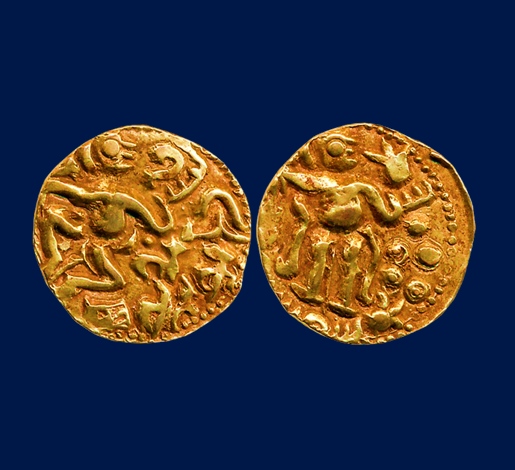
The history of Sri Lankan coinage offers fascinating insights into the political, commercial and cultural connections between the island and southern India. Among its notable examples is the anonymous gold Kahavanu, weighing 4.26 grams, featuring a seated king and a standing king. Associated with the Chola standard seated king type, this coin reflects the evolution of Sri Lanka's monetary traditions during a period of significant political change.
Ceylon maintained close connections with southern India through maritime trade, religious exchanges and political interactions. Around 993 CE, Rajaraja Chola I invaded Sri Lanka and conquered its northern territories, bringing them under Chola administration. Polonnaruwa subsequently became an important centre of their rule. Rajendra Chola I extended Chola control over much of the island around 1017–1018 CE. Chola dominance continued until Vijayabahu I restored Sinhalese rule in approximately 1070 CE.
This period brought Sri Lankan and South Indian political and monetary traditions into closer contact. However, the Kahavanu coinage tradition predated the Chola conquest, demonstrating that the Cholas inherited and interacted with an established local monetary system rather than creating it from scratch.
The Kahavanu was an important denomination in medieval Sri Lankan gold coinage. Its distinctive imagery remained recognisable across different political periods, although individual varieties differ in their inscriptions and details. Many issues are anonymous, making precise attribution to a particular ruler challenging.
The obverse of the coin depicts a king seated facing right, with his right arm raised and holding a conch shell (shankha). The accompanying Nagari inscription, Shri Lanka Vibhu, is interpreted as “Fortunate Lord of Sri Lanka.” The legend conveys royal authority and identifies the ruler symbolically with sovereignty over the island.
The reverse of the coin depicts, King enthroned, facing right, Votive lamps and Flower symbol on the right and Lamp, Alter on the left. Tiger skin below his legs. Such recurring imagery connects this coin with the broader Sri Lankan Kahavanu tradition.
The relationship between the Cholas and the Kahavanu illustrates how political conquest influenced monetary traditions. Chola rulers operated within a region where established coin designs already circulated, and their coinage reflected interactions with Sri Lankan monetary practices. The seated-king and standing-king motif is particularly associated with this numismatic tradition.
Although this specimen is described as belonging to the Chola standard seated-king type, its anonymous nature means that it should not automatically be attributed to a specific Chola monarch. Its historical importance lies in the continuity of Sri Lankan coinage during a period of South Indian political influence.
-
Goddess Laxmi holding Lotus and feeding Peacock on the Kumargupta I’s Gold Coin
2026-10-23 FriThe Gupta Empire (4th–6th centuries CE) occupies a distinguished place in Indian history, renow...
-
Bronze Coin of Zeionises, Kshatrapa of Chuksa
2026-10-22 ThuThe Indo-Scythians, also known as the Sakas, were Central Asian peoples who migrated into the nor...
-
Silver Drachma of the Western Kshatrapas Ruler Viradaman
2026-10-22 ThuThe Western Kshatrapas were an important dynasty that ruled parts of western and central India, p...
-
Silver Tetradrachm of the Northern Kshatrapas
2026-10-21 WedThe Kshatrapas of Kashmir form part of the fascinating history of the northwestern Indian subcont...
-
Numismatics Masterpiece - Gold Dodda Honnu of Krishnadevaraya, Vijayanagara Empire
2026-10-21 WedThe Vijayanagara Empire, founded in 1336, was one of the most influential powers in medieval Sout...